


What is Augmented Reality (AR)? Applications of AR
Augmented reality (AR) is changing the way we connect and interact in manufacturing. An enhanced version of the world around us, augmented reality is a combination of digital and audiovisual elements that bridges the real and digital worlds.
The use of AR is not limited to gaming and entertainment. For instance, the applications of AR in Manufacturing continue to grow and transform as per the requirements. Most of the AR applications are still in the early stages in the manufacturing industry, but it shows great potential. Moreover, the benefits of augmented reality are not just digital characters and images.
Across many industries, AR, has transformed from an exciting experiment to an everyday tool during the pandemic. Therefore, considering the Covid-19 Pandemic, the potential of AR will grow significantly. Therefore, in this article, we will learn what AR is and its various applications and benefits in manufacturing.
Across many industries, AR, has transformed from an exciting experiment to an everyday tool during the pandemic. Therefore, considering the Covid-19 Pandemic, the potential of AR will grow significantly. Therefore, in this article, we will learn what AR is and its various applications and benefits in manufacturing.
What is Augmented Reality?
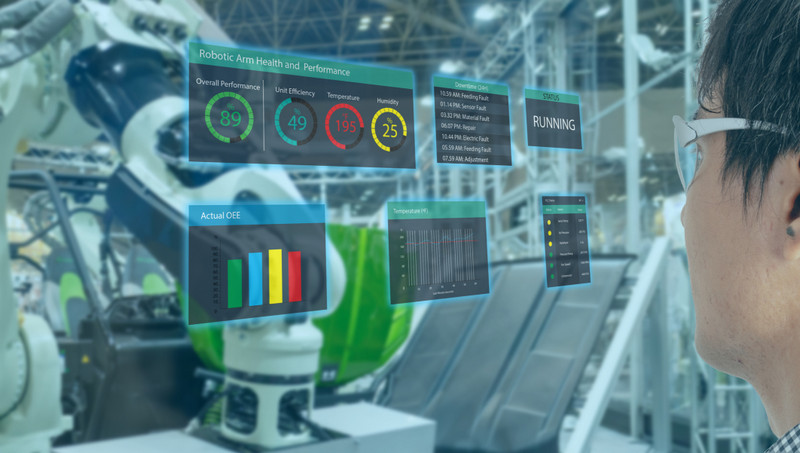
Augmented Reality is a technology that allows people to view objects in a specific environment. AR is an enhanced version of the real physical world achieved through the use of digital visual elements, audio, or other sensory stimuli and delivered through technology. It is a growing trend among companies involved in mobile computing and business applications in particular.
Augmented Reality AR has now become a widespread phenomenon across industries. The technology impacts entertainment, gaming, healthcare, and education. Now, AR applications are also providing solutions for the Manufacturing industry.
Examples of AR
Some early adopters in the retail sector have developed AR technologies designed to enhance the consumer shopping experience. Augmented reality has been integrated into store catalog applications, allowing consumers to visualize what different products will look like in different environments. For example, when buying furniture, the shopper points the camera at the appropriate room and the product appears in front of them.
Benefits and Role of AR Applications in Manufacturing
It is clear that the manufacturing industry is transforming and AR provides solutions that enable more features and functionalities in the industry. This, in turn, leads to greater flexibility, speed, accuracy, and efficiency in processes. Therefore, here are some of the important roles that AR applications play in Manufacturing processes:
- Enhance speed and quality
Manufacturing processes can be complex at times. Moreover, it requires experts and expertise to ensure efficiency. Therefore, with AR, engineers can have a schematic view of the processes. This, in turn, allows them to identify loopholes. This results in a 30% increase in the speed of the process.
- Resolve any issues that occur on the floor
Production floors are constantly faced with issues and problems. This can lead to delays or pauses in processes. Therefore, it is important to identify and resolve issues at the earliest.
With the applications of AR in manufacturing processes, these milestones can be quickly identified and addressed in real-time. Furthermore, it allows different teams and engineers to address issues while they work on other functions. Most importantly, it is easier to detect and fix issues without affecting the production process.
- Streamline data access
All manufacturing processes generate a significant amount of data. This data is therefore contained in various instructions, schematics, manuals, and user programs. Furthermore, there is traceable data for all functions running on the production floor.
However, going through, sorting and classifying this data is a time-consuming task. Therefore, AR streamlines the process of data collection. Moreover, it allows real-time access to troubleshoot issues. It also allows quick searches to provide maintenance and repair instructions. Therefore, training and guiding new employees and team members becomes easier. It also allows them to access data to documents and master information.
- Reduced maintenance time
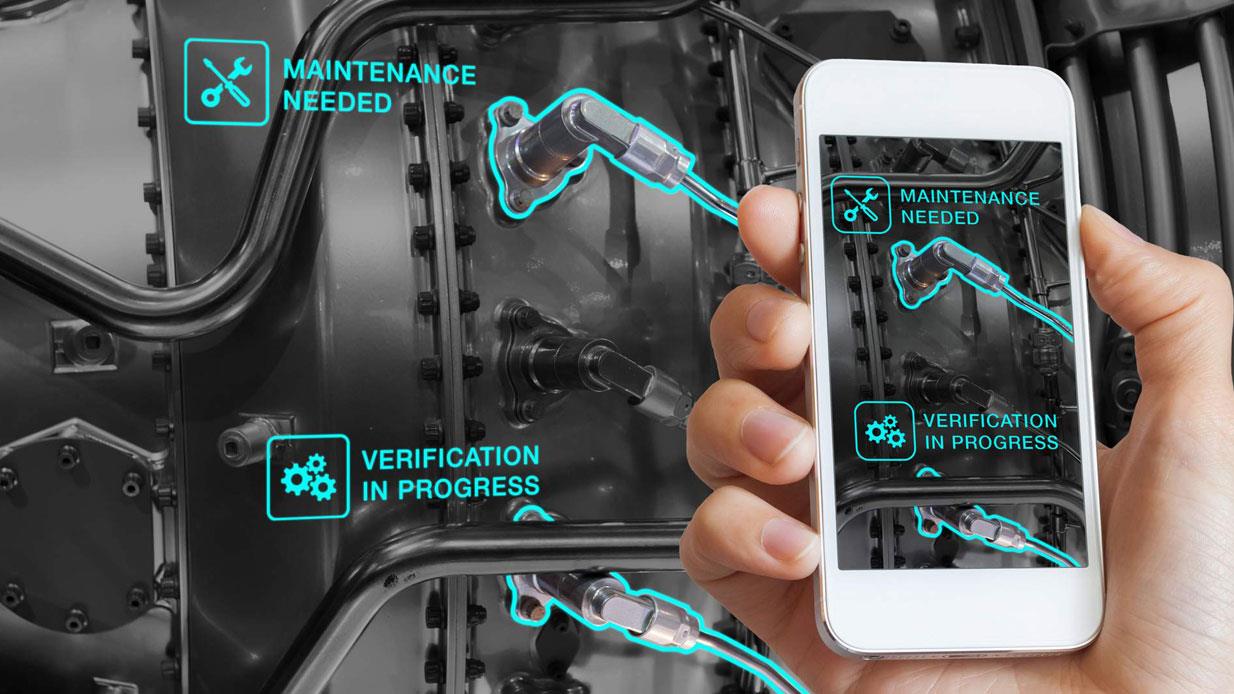
AR provides complete access to data when required. There is definitely a requirement for maintenance and management of components. Furthermore, AR identifies faults and then generates instructions and documents containing information for system repair and maintenance. Therefore, it provides a concise solution to repair and maintain components in the least amount of time. Above all, it allows access to anyone who is part of the process to understand and execute critical tasks.
- Prevent errors and downtime
While AR provides the fastest solutions to problems, some problems may take longer to resolve. Moreover, certain problems can also stop the production process leading to downtime.
Therefore, with the application of AR in the manufacturing process, businesses can use this feature to superimpose virtual images on real objects or scenarios. As a result, it can identify any loopholes or flaws in the process. Thus, alerting the teams and addressing it before it negatively impacts the process.
- Faster product prototyping and design
The manufacturing industry is very competitive. Moreover, businesses are always under pressure to provide innovative, fast, efficient and cost-effective solutions. Therefore, AR enhances and augments the existing product and its service designs. It then gathers information for a completely new or more efficient manufacturing technique.
Top Applications of AR in Manufacturing
Here are some real-world examples of businesses successfully using AR:
- AR in Manufacturing for Design
Companies use this technology to make quick decisions and approve designs in real-time. It also allows sales teams to use the technology to provide customers with more visuals. AR applications provide efficient productivity and opportunities to delight customers.
- AR in Manufacturing for Assembly
Boeing is a world leader in the production of commercial jets. Furthermore, it uses AR technology to simplify the complex wiring process for its 787-8 Freighter. They are currently using Upskill’s Google Glass and Skylight software platforms to enhance their wiring tasks.
Initially, Boeing started with charts and laptops to complete their basic tasks and issues. Moreover, technicians had to constantly refer to schematics for assembly instructions. Therefore, with the AR solution, technicians now get instructions when needed. Additionally, through the Google Glass touchpad, voice commands and head tracking interface instructions are easily available. On top of that, the implementation of the AR solution helped the organization save 25% of the time in wiring processes.
- AR application for personnel training
The application allows technicians to easily access the dashboard using an iPad and see everything hidden in the dashboard. It also identifies the exact location and interaction with different components. It also creates connections through sensors and wiring diagrams. Thus, it helps instructors to perform training exercises on real vehicles without having to disassemble and reassemble.
- AR Applications in Manufacturing for Quality Control
The factory uses robots for repetitive tasks and uses AR for quality control. The company is also conducting experiments with AR to see if the technology is suitable for providing accurate information about components. Therefore, with AR, engineers can gather information about any potential problems.
- AR Applications in Manufacturing for Inventory Management
DHL is a well-known shipping and logistics company. Moreover, it is constantly working towards better speed and accuracy for inventory management. The company has introduced an augmented reality manufacturing application with Google Glass and other AR solutions. It also uses displays to improve warehouse efficiency.
The technology provides workers with navigation solutions for inventory management. Ultimately, the pilot study for the app worked with 10 order pickers, completing 9,000 orders consisting of 20,000 items. Most importantly, the app was a success in enabling efficient operations and reducing error rates. DHL is thus making excellent use of AR for better productivity and efficiency while improving customer satisfaction.
Conclusion
In short, AR applications in the Manufacturing Industry benefit individuals and organizations. It also reduces the likelihood of errors and improves the design and manufacturing process. The expansion of human-machine collaboration is opening up new ways to connect our factories and interact with data. Businesses across industries are benefiting from the solutions for manufacturing training, standardization, optimization, and overall employee well-being.
See more:
Những câu hỏi thường gặp


