


8 Tips for Proper Conveyor Belt Maintenance
Proper maintenance of conveyor belts is important to ensure their performance and prolong their life.
To ensure the continuous performance and longevity of conveyor belts, companies often remove inactive or empty conveyor belts from the production line and store them in a designated warehouse. Additionally, companies should maintain a stock of spare belts to minimize the risk of unplanned downtime due to belt failure, as there is no better and faster resource than your own backup plan. In this article, we will guide you on how to properly and efficiently store conveyor belts.

How to store conveyors properly
When it comes to storing conveyor belts, proper procedures need to be followed to maintain their quality and functionality. We will provide you with 8 useful tips on different types of conveyor belt storage.
1 - Proper Temperature and Humidity
To maintain the integrity of conveyor belts, it is important to store them in a suitable environment with controlled temperature and humidity. Extreme temperatures can lead to belt degradation, hardening or deformation, while excessive humidity can promote the growth of mold or corrosion.
Conveyor belts should be stored in a warehouse with temperatures ranging from 18-40oC and relative humidity maintained between 50-80%. By ensuring ideal storage conditions, you can protect the quality and performance of your conveyor belt.
2 - Location requirements
There must be no stress, as stress can cause permanent deformation of the belt or breakage of the tension belt. Therefore, it is important to ensure that industrial belts are stored without any form of stress.
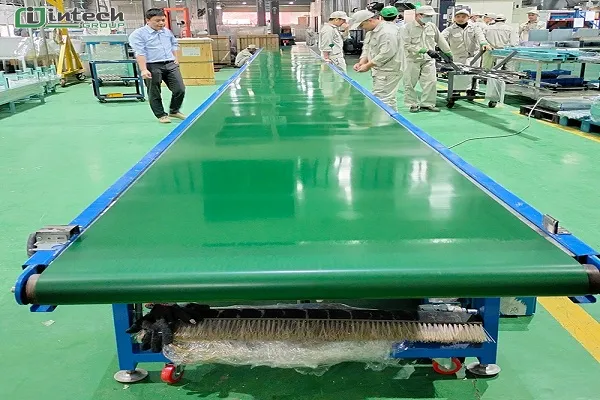
3 - Protection against light and ultraviolet rays
Conveyor belts, especially those made of rubber or plastic materials, can be easily damaged by prolonged exposure to direct sunlight. It is essential to store conveyor belts in an area that is sheltered from direct sunlight. Taking appropriate sun protection measures can further protect them. For outdoor storage of belts, choose materials that are UV resistant or use additional protective measures to minimize the effects of UV radiation.
4 - Prevent exposure to chemicals
Certain chemicals can corrode or damage conveyor belts. During storage, it is important to prevent contact between the belt and substances such as acids, alkalis, oils and solvents. If there is a possibility of the belt coming into contact with these substances, it is recommended to choose specially designed conveyor belts with chemical resistance properties or apply additional protective measures. By taking these precautions, the integrity and life of the belt can be preserved.
5 - Keep away from the ozone layer
In the conveyor storage area, avoid electrical equipment that can generate ozone such as fluorescent lamps, mercury vapor lamps or high voltage electrical equipment. Gases and vapors that can lead to ozone formation through photochemical processes must be avoided or eliminated.
6 - Avoid deformation and damage:
To prevent deformation and damage to conveyor belts, it is important to store them in a way that minimizes compression and bending over long periods of time. Ideally, conveyor belts should be stored in rolls rather than stacked or excessively folded. If belt storage is extended, the belt should be rotated every two months to evenly distribute the pressure and avoid excessive tension on one side.
7 - Clean and keep dry
Before storing conveyor belts, ensure that their surfaces are clean and free of any debris that could cause contamination or corrosion. In addition, conveyor belts should be kept dry and protected from damp environments to prevent mold growth or corrosion.
8 - Regular inspection and maintenance
Regularly inspect stored conveyors, especially those that have been stored for a long time, to ensure that they are in good condition. Pay attention to whether there are obvious signs of aging, damage or deformation. During the storage period, some maintenance measures can be taken in time, such as applying appropriate protective agents or adjusting the storage location to keep it in good condition.
In summary, when storing conveyors, it is necessary to pay attention to temperature and humidity control, protection from light and ultraviolet rays, avoiding contact with chemicals, preventing deformation and damage, keeping them clean and dry, and regular inspection and maintenance. These considerations can help protect the quality and performance of the belt, extend the life of the belt, and ensure smooth material transportation when needed.

Conveyor storage checklist
Here is a checklist you need to know to check for proper conveyor storage
- Choose the right storage location
Choose a warehouse or storage area that is clean, dry, and temperature-controlled. Avoid direct sunlight, extreme temperatures, humidity, or corrosive substances that can damage the belt material.
- Clean and inspect the belt
Before storing, thoroughly clean the belt to remove any debris or dirt. Inspect it for any signs of damage or wear that may require repair or replacement.
Before storing, clean the belt thoroughly to remove any debris or dirt. Check for any signs of damage or wear that may require repair or replacement.
- Outer packaging
After selecting the environment, to extend the storage life of industrial conveyor belts, businesses need to pay attention to the outer packaging of the conveyor belt. Highly sealed packaging can be selected to reduce contact between the conveyor belt and the air and avoid oxidation reactions at different levels.
- Inventory rotation
Implement a first-in, first-out (FIFO) system to ensure that old belts are used first. Inventory is regularly checked for expiration dates (if applicable) and rotated accordingly to prevent the use of expired or degraded belts. By following proper conveyor belt storage practices, companies can maximize the life and performance of their conveyor belts.
Conclusion
Whether you are an end user of conveyor belts or run a wholesale conveyor belt business, we aim to provide you with valuable advice for proper conveyor belt maintenance. Our guide is designed to assist you in maintaining the quality and performance of your belts. By following these industrial conveyor belt maintenance recommendations, you can ensure that your conveyors are well maintained and ready for use when needed.
Những câu hỏi thường gặp


