


What is an industrial robot? (What is an industrial robot)
Industrial robots reduce or eliminate the human factor to gain various advantages in terms of speed, capacity and processing quality.
Industrial robotics is commonly used to refer to a robotic arm used in a factory environment for manufacturing applications. Traditional industrial robots can be classified according to different criteria such as movement type, application, architecture and brand. This article will help us learn about the benefits and applications of industrial robots.
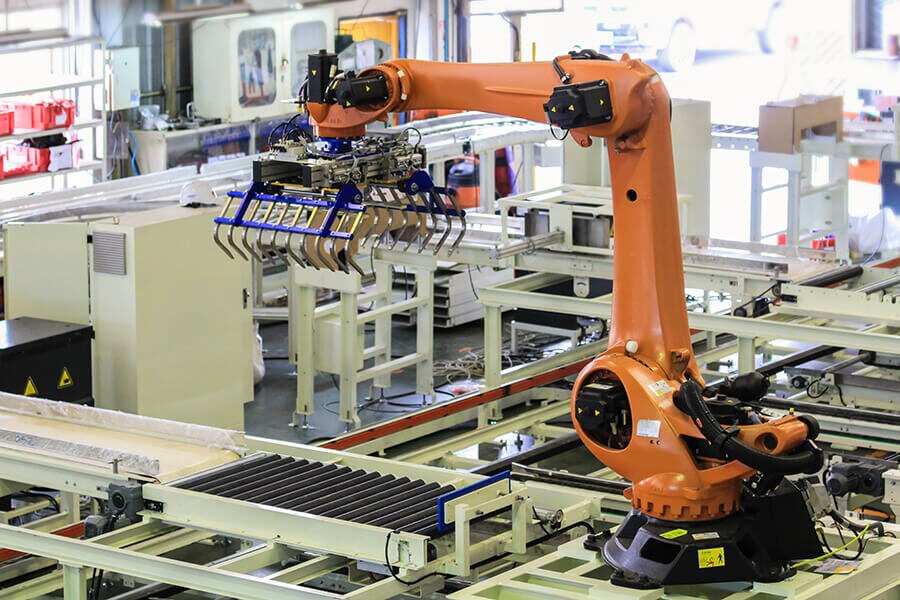
An industrial robot, also known as an industrial robot, is an automated system of sensors, controllers and actuators that performs specific functions and activities in a production or processing line. They operate continuously through cycles of repetitive motion guided by a set of instructions called a program. These machines minimize or eliminate the human factor to gain various advantages in terms of speed, capacity and processing quality.
![]()
The four main parts of an industrial robot are the controller, the arm, the human interface device, and the power supply. The arm has a controller that is the "brain" of the system. The arm is a structure made up of links and joints. Links are hardware components that move through space within the robot's range. Joints, on the other hand, are a mechanical part that connects two links that simultaneously allow reciprocating (prismatic) or rotational (revolving) motion. The configuration of these two components classifies different types of industrial robots.
The controller holds the programming code and receives the signal from the system (input), processes the signal, and then sends the signal out to the system (output) to control the robot. One type of input could come from a human interface device, such as a teaching pendant. These devices can be used to program the arm and control its movement. The power supply is where the industrial robot gets power for its controller and actuator. This is usually in the form of electrical energy.
We will learn about the advantages of using industrial robots in the production system. Although investment and capital costs are higher, some economic and intangible benefits can be obtained. Due to their efficient operation, industrial robots are well worth the investment and can recoup their value in 2 to 5 years.
Higher production speeds are the number one reason to invest in industrial robotics systems. The robot does not get tired, nor slow down after continuous operation. When properly designed, operated and maintained, they can effectively reduce production time. Their processing speed is much faster than humans. This allows them to perform a wide range of calculated movements, quickly, regardless of complexity.
Industrial robots have many times more powerful actuators than human robots. Their actuators rely on the pressure generated by hydraulic and pneumatic systems, and the electromagnetic force exerted by different types of actuators and electric motors. Industrial robots also take advantage of mechanics due to specially designed arm profiles that are, in their basic form, just plain machines. All these factors allow the robot to lift heavy objects with ease and efficiency far beyond the capabilities of manual labor.
Common hazards in the workplace include extreme temperatures, high pressures, hazardous materials, heavy loads, rapid movements, and high-speed rotation. Industrial robots are useful in operations involving these hazards to eliminate the risk of injury or even death. They are more serviceable and can better withstand harmful working conditions. They can also be repaired if damage persists. Furthermore, robots improve safety in the workplace as they do not make mistakes or cause accidents due to poor judgment unlike operators. But this is only true if the robot is well designed and programmed.
Less wasted raw materials and less labor costs are some of the economic benefits that industrial robots bring. These are operational savings in addition to higher profits due to better product quality and faster production speeds. The efficient use and handling of raw materials is due to the precise and precise operation of the robotic systems. This further leads to lower product rejection rates. In terms of labor costs, operations that use manual labor are typically more expensive for the same amount of work. There are many miscellaneous costs associated with manual labor such as government-mandated benefits, living and training allowances.
In a robotic system, the way it behaves is consistent despite running after hundreds or thousands of cycles. Without human intervention or changes in their program, robots can effectively perform the same sequence of operations over and over again with precision and accuracy. Its movement patterns, range of motion, impact force, speed and other operating parameters are less affected by external factors. This results in consistent and predictable product quality and operating speeds.
The robotic system inherently has a higher operating accuracy than the operator. They can easily perform the exact actions intended by their program. This property is important in manufacturing processes that require tight tolerances such as the manufacture of automotive and aircraft parts. The accuracy of robotic systems is improved by attaching sensors, which allow the machine to recognize and analyze its work envelope. As the sensor's sophistication is increased, the robot's accuracy also improves.
Today, industrial robots are the device behind every precision manufacturing and manufacturing process. This is attributed to both repeatability and precision. These characteristics allow the robot to create products with consistent properties that are free from common mistakes and subjective judgments. The robot can also be fitted with a suitable set of tools to do the job accurately and smoothly without damaging the finished product.
Due to their higher load capacity, faster throughput and integrated tool system, industrial robots save space effectively. No additional equipment is required to assist operators in doing their jobs. Manufacturing through manual labor often requires a larger space to accommodate several workstations in order to increase the productivity of the production line. The same can be achieved by a single industrial robot.
The most common application of industrial robots involves simple pick and place operations. However, with the advent of better control technology, more powerful actuators and more complex sensors, industrial robots are also used in more important and flexible functions. Here are some of the most common applications of industrial robots.
Industrial robots are widely used as assembly machines. They are suitable for repetitive but precise tasks that are tedious for a single operator. Their EOAT is usually a mechanical gripper that picks, places, and orients small or large parts in rapid succession. Sensors are optional and are commonly used to recalibrate the accuracy of robot movements.
Conventional machining processes include milling, drilling and turning. Machining typically uses a rotary cutter to remove material from the workpiece. When done by hand, it involves the gradual transfer of the rotary cutter to the workpiece. It is also possible to raise the workpiece by moving it on the table of the machine. The direction and extent of cuts made through the manual process are limited due to limited machine control and movement. When using an industrial robot, a rotary cutter is installed on the robot as its EOAT. Using a robot as a cutting tool operator allows greater control over all cutting parameters such as cutter speed, depth, pressure and feedrate.
Common non-conventional machining methods include waterjet cutting, laser cutting, abrasive beam machining, discharge machining (EDM), and plasma cutting. These are contactless machining processes that remove material using high concentrations of water, light, electrical charges or another physical entity. Concentrating currents erode, vaporize or melt the material. A large amount of energy is involved in these processes; this can damage the product or the machine itself if not properly controlled. To precisely control the cutting path of the machine, industrial robots are used. Consistent cutting speed, line stability and precise control of machine parameters such as power, pressure and flow rate are properly maintained using digital control.
Robotic welders are commonly found in automotive manufacturing plants, but they are also widely used in many high-volume metal fabrication processes. Increased market competition creates a demand for better product quality and higher operating speeds. This, in turn, requires more precise and precise welding processes. The main advantage of using industrial robots in welding is better control over various parameters such as current, voltage, arc length, feed rate, weld speed and travel speed. arc.
Painting and coating is a sensitive operation that requires repetitive and highly precise movements to produce a layer of uniform thickness. In addition to the required precision and accuracy, painting involves working with potentially hazardous chemicals. Many colorants and solvents are toxic, and some can even create explosive atmospheres. All these risks are minimized by the use of industrial robots.
Grinding, polishing, and polishing are common secondary fabrication processes used to improve the final appearance and surface properties of a product. These processes involve repetitive, oscillating movements of abrasive or polishing materials. This simple movement of the tool can easily be imitated with a robotic arm.
Machine loading and unloading takes advantage of the high load-carrying capacity and mechanical advantages offered by robotic systems. Specific machine handling applications include transferring large metal or plastic parts from casting, casting and forging to conveyor systems or secondary processing stations.
The robotic test machine uses measuring devices such as optical sensors, proximity sensors, force transducers and ultrasonic transducers. These machines are often used to accurately measure the dimensions of products in order to maintain quality and consistency. Other inspection applications include non-destructive testing (NDT) of welds, where transducers or ultrasonic arrays are automatically moved and controlled by a robotic system.
Sorting processes utilize the simple pick and place capabilities and high speed monitoring of robotic systems. The intuitive sensor detects variations in size, color, or shape. When an odd item is detected, a robot will be used to select and reject the item. Common industries that use robotic sorting systems are pharmaceuticals and electronics.
Industrial robots are considered a flexible form of automation because they are reprogrammable and can be used for many different types of robotic applications. Robots are increasingly becoming the preferred automation choice for manufacturers as they are extremely effective for increasing productivity, producing high quality products and reducing costs.
Related Posts:
What is an industrial robot?
An industrial robot, also known as an industrial robot, is an automated system of sensors, controllers and actuators that performs specific functions and activities in a production or processing line. They operate continuously through cycles of repetitive motion guided by a set of instructions called a program. These machines minimize or eliminate the human factor to gain various advantages in terms of speed, capacity and processing quality.
Structure of industrial robot
The four main parts of an industrial robot are the controller, the arm, the human interface device, and the power supply. The arm has a controller that is the "brain" of the system. The arm is a structure made up of links and joints. Links are hardware components that move through space within the robot's range. Joints, on the other hand, are a mechanical part that connects two links that simultaneously allow reciprocating (prismatic) or rotational (revolving) motion. The configuration of these two components classifies different types of industrial robots.
The controller holds the programming code and receives the signal from the system (input), processes the signal, and then sends the signal out to the system (output) to control the robot. One type of input could come from a human interface device, such as a teaching pendant. These devices can be used to program the arm and control its movement. The power supply is where the industrial robot gets power for its controller and actuator. This is usually in the form of electrical energy.
Top 8 Advantages of Industrial Robots
We will learn about the advantages of using industrial robots in the production system. Although investment and capital costs are higher, some economic and intangible benefits can be obtained. Due to their efficient operation, industrial robots are well worth the investment and can recoup their value in 2 to 5 years.
1 - Faster production speed:
Higher production speeds are the number one reason to invest in industrial robotics systems. The robot does not get tired, nor slow down after continuous operation. When properly designed, operated and maintained, they can effectively reduce production time. Their processing speed is much faster than humans. This allows them to perform a wide range of calculated movements, quickly, regardless of complexity.
2 - Higher load capacity:
Industrial robots have many times more powerful actuators than human robots. Their actuators rely on the pressure generated by hydraulic and pneumatic systems, and the electromagnetic force exerted by different types of actuators and electric motors. Industrial robots also take advantage of mechanics due to specially designed arm profiles that are, in their basic form, just plain machines. All these factors allow the robot to lift heavy objects with ease and efficiency far beyond the capabilities of manual labor.
3 - Improve Safety:
Common hazards in the workplace include extreme temperatures, high pressures, hazardous materials, heavy loads, rapid movements, and high-speed rotation. Industrial robots are useful in operations involving these hazards to eliminate the risk of injury or even death. They are more serviceable and can better withstand harmful working conditions. They can also be repaired if damage persists. Furthermore, robots improve safety in the workplace as they do not make mistakes or cause accidents due to poor judgment unlike operators. But this is only true if the robot is well designed and programmed.
4 - Lower operating costs:
Less wasted raw materials and less labor costs are some of the economic benefits that industrial robots bring. These are operational savings in addition to higher profits due to better product quality and faster production speeds. The efficient use and handling of raw materials is due to the precise and precise operation of the robotic systems. This further leads to lower product rejection rates. In terms of labor costs, operations that use manual labor are typically more expensive for the same amount of work. There are many miscellaneous costs associated with manual labor such as government-mandated benefits, living and training allowances.
5 - Better repeatability and accuracy:
In a robotic system, the way it behaves is consistent despite running after hundreds or thousands of cycles. Without human intervention or changes in their program, robots can effectively perform the same sequence of operations over and over again with precision and accuracy. Its movement patterns, range of motion, impact force, speed and other operating parameters are less affected by external factors. This results in consistent and predictable product quality and operating speeds.
6 - High accuracy:
The robotic system inherently has a higher operating accuracy than the operator. They can easily perform the exact actions intended by their program. This property is important in manufacturing processes that require tight tolerances such as the manufacture of automotive and aircraft parts. The accuracy of robotic systems is improved by attaching sensors, which allow the machine to recognize and analyze its work envelope. As the sensor's sophistication is increased, the robot's accuracy also improves.
7 - Excellent product quality:
Today, industrial robots are the device behind every precision manufacturing and manufacturing process. This is attributed to both repeatability and precision. These characteristics allow the robot to create products with consistent properties that are free from common mistakes and subjective judgments. The robot can also be fitted with a suitable set of tools to do the job accurately and smoothly without damaging the finished product.
8 - More compact production area:
Due to their higher load capacity, faster throughput and integrated tool system, industrial robots save space effectively. No additional equipment is required to assist operators in doing their jobs. Manufacturing through manual labor often requires a larger space to accommodate several workstations in order to increase the productivity of the production line. The same can be achieved by a single industrial robot.
Top 9 Robot Applications Popular Industry
The most common application of industrial robots involves simple pick and place operations. However, with the advent of better control technology, more powerful actuators and more complex sensors, industrial robots are also used in more important and flexible functions. Here are some of the most common applications of industrial robots.
1 - Product assembly:
Industrial robots are widely used as assembly machines. They are suitable for repetitive but precise tasks that are tedious for a single operator. Their EOAT is usually a mechanical gripper that picks, places, and orients small or large parts in rapid succession. Sensors are optional and are commonly used to recalibrate the accuracy of robot movements.
2 - Processing:
Conventional machining processes include milling, drilling and turning. Machining typically uses a rotary cutter to remove material from the workpiece. When done by hand, it involves the gradual transfer of the rotary cutter to the workpiece. It is also possible to raise the workpiece by moving it on the table of the machine. The direction and extent of cuts made through the manual process are limited due to limited machine control and movement. When using an industrial robot, a rotary cutter is installed on the robot as its EOAT. Using a robot as a cutting tool operator allows greater control over all cutting parameters such as cutter speed, depth, pressure and feedrate.
3 - Non-conventional machining:
Common non-conventional machining methods include waterjet cutting, laser cutting, abrasive beam machining, discharge machining (EDM), and plasma cutting. These are contactless machining processes that remove material using high concentrations of water, light, electrical charges or another physical entity. Concentrating currents erode, vaporize or melt the material. A large amount of energy is involved in these processes; this can damage the product or the machine itself if not properly controlled. To precisely control the cutting path of the machine, industrial robots are used. Consistent cutting speed, line stability and precise control of machine parameters such as power, pressure and flow rate are properly maintained using digital control.
4 - Welding:
Robotic welders are commonly found in automotive manufacturing plants, but they are also widely used in many high-volume metal fabrication processes. Increased market competition creates a demand for better product quality and higher operating speeds. This, in turn, requires more precise and precise welding processes. The main advantage of using industrial robots in welding is better control over various parameters such as current, voltage, arc length, feed rate, weld speed and travel speed. arc.
5 - Paint and coating:
Painting and coating is a sensitive operation that requires repetitive and highly precise movements to produce a layer of uniform thickness. In addition to the required precision and accuracy, painting involves working with potentially hazardous chemicals. Many colorants and solvents are toxic, and some can even create explosive atmospheres. All these risks are minimized by the use of industrial robots.
6 - Grinding, polishing and polishing:
Grinding, polishing, and polishing are common secondary fabrication processes used to improve the final appearance and surface properties of a product. These processes involve repetitive, oscillating movements of abrasive or polishing materials. This simple movement of the tool can easily be imitated with a robotic arm.
7 - Loading and Unloading the machine:
Machine loading and unloading takes advantage of the high load-carrying capacity and mechanical advantages offered by robotic systems. Specific machine handling applications include transferring large metal or plastic parts from casting, casting and forging to conveyor systems or secondary processing stations.
8 - Check:
The robotic test machine uses measuring devices such as optical sensors, proximity sensors, force transducers and ultrasonic transducers. These machines are often used to accurately measure the dimensions of products in order to maintain quality and consistency. Other inspection applications include non-destructive testing (NDT) of welds, where transducers or ultrasonic arrays are automatically moved and controlled by a robotic system.
9 - Sort:
Sorting processes utilize the simple pick and place capabilities and high speed monitoring of robotic systems. The intuitive sensor detects variations in size, color, or shape. When an odd item is detected, a robot will be used to select and reject the item. Common industries that use robotic sorting systems are pharmaceuticals and electronics.
Ending
Industrial robots are considered a flexible form of automation because they are reprogrammable and can be used for many different types of robotic applications. Robots are increasingly becoming the preferred automation choice for manufacturers as they are extremely effective for increasing productivity, producing high quality products and reducing costs.
Related Posts:
- Conveyor problems and how to fix them effectively
- What is an inverter for a conveyor? Uses and benefits of use
- Application of Assembly Automation in industrial automation


