


What is a Hydraulic Robot Arm? Structure & Applications in Industry
With superior properties of strength and durability, hydraulic robot arms play a special role and importance in modern industries, especially heavy industry.
In the era of industry 4.0, the advent of robots has revolutionized many manufacturing fields. Among them, hydraulic robot arms have emerged as a powerful and reliable solution, especially in applications that require the ability to lift large loads and operate in harsh environments.
Operated based on the principle of liquid pressure transmission, these mechanical arms not only bring outstanding performance but also ensure stability and durability, becoming an indispensable part of many modern heavy industries.
Operated based on the principle of liquid pressure transmission, these mechanical arms not only bring outstanding performance but also ensure stability and durability, becoming an indispensable part of many modern heavy industries.
What is a Hydraulic Robot Arm?
A hydraulic robot arm is a type of industrial robot that operates based on the principle of liquid pressure transmission (usually hydraulic oil) to create movement and force.
The fundamental and outstanding difference between a hydraulic robot arm and an electric robot (using an electric motor) or a pneumatic robot (using compressed air) lies in the operating energy source and the ability to generate force. Hydraulic robots have the ability to generate superior force, withstand very high loads, and operate stably even in harsh environments. This is in contrast to electric robots, which often have higher precision in light applications, and pneumatic robots, which are suitable for simple jobs that require fast speed but not much force.
Structure of a Hydraulic Robot Arm
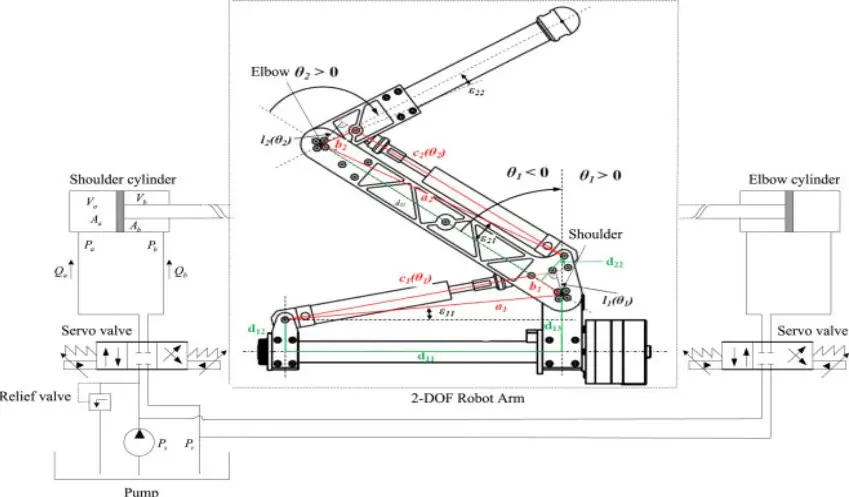
The detailed structure of a hydraulic robot arm includes three main systems that operate synchronously to perform specific movements and tasks: the mechanical system (arm), the hydraulic system, and the control system.
1 - Mechanical system (arm):
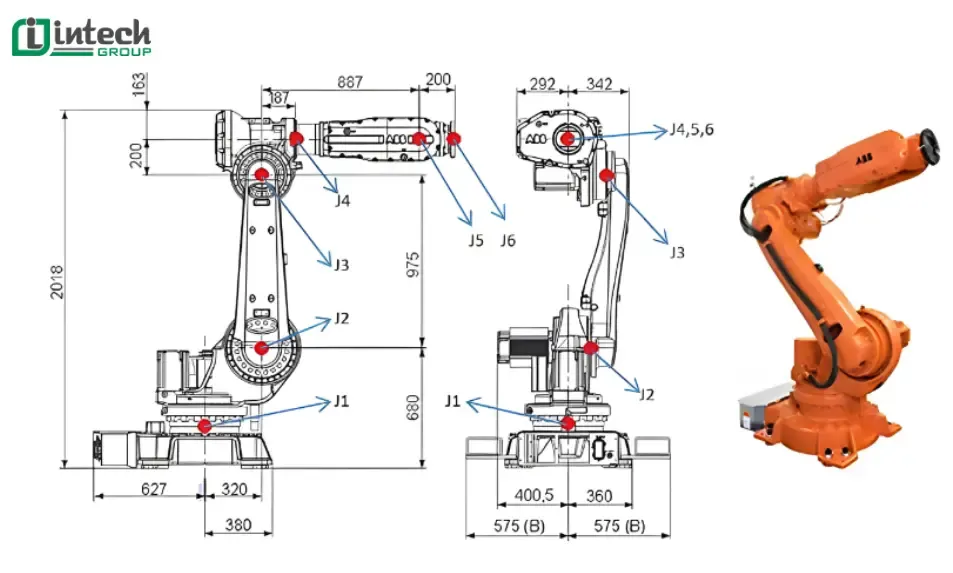
- Joints: The hydraulic robot arm is made up of many sections connected together through joints. These joints can be:
+ Rotary Joints: Allow the arm parts to rotate around an axis, creating rotational motion.
+ Prismatic Joints: Allow the arm parts to slide or extend in a straight line, creating translational motion.
+ Prismatic Joints: Allow the arm parts to slide or extend in a straight line, creating translational motion.
- Degrees of Freedom: The number and type of joints will determine the number of degrees of freedom of the robot arm, affecting its ability to move and manipulate in space. The more degrees of freedom a robot arm has, the more flexible it is.
- Material structure: Usually made from high-strength metal materials such as alloy steel or specialized aluminum, ensuring rigidity and the ability to withstand large loads.
- Endpiece: This is the part attached to the end of the robot arm, specifically designed for each specific application. For example: Clamps for lifting or holding objects.
2 - Hydraulic system:
- This is the heart of the hydraulic robot arm, responsible for generating and transmitting energy:
- Hydraulic pump: This device creates pressure for the hydraulic oil. The pump is driven by an electric motor or an internal combustion engine.
- Hydraulic cylinder: Converts the pressure energy of the oil into translational motion (push/pull), often used for translational joints or creating linear forces.
- Hydraulic motor: Converts the pressure energy of the oil into rotational motion, used for rotary joints or driving parts that require large torque.
- Control valve: These valves play an important role in directing the flow of hydraulic oil, controlling pressure and flow, thereby controlling the speed, direction and force of the movements of the robot arm. There are many types of valves such as distribution valves, throttle valves, pressure valves.
- Oil tank: Contains the amount of hydraulic oil needed for the system, while also helping to dissipate heat and settle dirt.
- Filter: Placed on the oil line to remove impurities, protecting other components of the system from damage.
- Pipes: High-pressure pipes and hoses used to transfer hydraulic oil between parts.
3 - Control system:
- This is the brain of the robot arm, responsible for managing and coordinating all operations:
- Controller: Usually a Programmable Logic Controller (PLC) or a dedicated industrial computer. This controller contains programs and algorithms to command valves and pumps to operate according to the desired cycle.
- Sensors: Integrated to collect data on the current state of the robot, including:
+ Position sensor: Measures the position of joints or cylinders to ensure accuracy.
+ Pressure sensor: Monitors pressure in the hydraulic system.
+ Force Sensors: Measure the force acting on the end member or joints.
+ Pressure sensor: Monitors pressure in the hydraulic system.
+ Force Sensors: Measure the force acting on the end member or joints.
- Feedback system: Data from the sensors is sent to the controller to compare with the desired values. If there is a deviation, the controller will adjust the valves and pumps to bring the robot to the correct position or perform the required force, ensuring accuracy and stability.
- Human-Machine Interface (HMI): A touch screen or control panel helps the operator set up, monitor and adjust the robot's operation.
Operating principle of hydraulic robot arm
Hydraulic robot arms operate based on Pascal's law, in which pressure is transmitted evenly in an incompressible fluid (usually water or hydraulic oil). The system uses hydraulic cylinders (syringes in a simple model) to create pushing or pulling force, controlling the movement of the joints. A pump and valve system controls the flow of fluid to perform movements such as rotating, lifting, lowering, picking up and dropping objects.
Advantages and Disadvantages of Hydraulic Robot Arms
Hydraulic robot arms are an important automation technology in industry, using hydraulic systems to create force and movement. Below is a detailed analysis of the advantages and disadvantages of this type of robot:
Advantages of hydraulic robot arms:
- Strong force and high load capacity: Hydraulic robot arms are capable of handling large loads (from several hundred kilograms to tons), superior to electric robots, suitable for applications such as lifting steel or heavy packaging in detergent production.
- High durability: The hydraulic system operates stably in harsh environments (high temperatures, dust), ensuring a long service life when properly maintained.
- Flexible precision: With the support of PLC and sensors, the arm can perform complex movements (4-6 axes) with high precision, especially in automated lines.
- Continuous operation capability: Suitable for 24/7 operating lines, such as loading and unloading detergent bags, thanks to its outstanding load capacity and durability.
Disadvantages of hydraulic robot arms:
- High maintenance costs: Hydraulic systems require regular maintenance (oil changes, valve and cylinder inspections), resulting in higher operating costs than electric robots.
- Large size and load capacity: Due to the use of pumps and cylinders, hydraulic robot arms are often bulky, not suitable for limited factory space.
- Risk of oil leakage: If the system fails (valves, pipes), hydraulic oil can leak, polluting the environment and affecting production hygiene (e.g. food industry).
- Limited speed: Compared to electric robots, the movement speed of hydraulic arms is slower due to dependence on oil flow, not ideal for processes that require quick reactions.
Common applications of Hydraulic Robot Arms
They are used to automate heavy, dangerous, repetitive tasks, helping to increase productivity, improve product quality and reduce production costs.
- Industrial manufacturing: Used to lift, move and assemble heavy components such as engines, car frames, or steel in production lines.
- Construction industry: Perform tasks such as moving concrete, bricks, or heavy machinery on construction sites.
- Warehousing and Logistics industry: Arrange and transport heavy goods such as steel pallets or containers in warehouses.
- Energy and mining industry: Assist in moving heavy equipment or raw materials such as coal, iron ore.
- Marine industry: Perform loading and unloading of goods on ships or ports, especially heavy materials such as steel coils.
Comparing Hydraulic Robot Arms with Electric/Pneumatic Robot Arms
Here is a summary table comparing hydraulic robot arms with electric and pneumatic robot arms, focusing on the main features:
| Features | Hydraulic Robot Arm | Electric Robot Arm | Pneumatic Robot Arm |
| Power Source | Hydraulic oil (high pressure) | Electric motor (servo/stepper) | Compressed air |
| Force generated | Very large, outstanding, high load capacity | Medium to high (depending on motor power), enough for many applications | Low, suitable for light loads |
| Position accuracy | Lower than electric robots (due to oil compressibility, hysteresis) | Very high, good accuracy and repeatability, suitable for meticulous work | Medium to low, difficult to control precise position |
| Speed | Medium to fast | Fast to very fast | Very fast (for simple movements) |
| Operating environment | Harsh (high temperature, dust, vibration) | Less harsh, requires clean environment (especially collaborative robots) | Usually clean environment, free of dust |
| Noise & Vibration | High (due to pump and high pressure oil flow) | Low (smooth) | Low (but may have compressed air hissing) |
| Maintenance | Complex, requires periodic maintenance requirements (leakage checks, oil changes, filters) | Simpler, less routine maintenance requirements | Simpler, less maintenance requirements |
| Contamination risk | Yes (oil leaks) | No | No |
| Cost | High (initial investment and operation) | Medium to high (depending on type and load capacity) | Low (initial investment) |
| Typical applications | Heavy industry (casting, forging, demolition, mining), automotive (frame welding, heavy assembly) | Precision assembly, spot welding, spray painting, pick & place, collaboration | Sorting, packaging, light pick & place, simple, fast-repeat tasks |
Movements of Hydraulic Robot Arms
Hydraulic robot arms, similar to other types of robot arms, are capable of performing a variety of movements thanks to their articulated structure and hydraulic drive system. These movements are often described based on the robot's Degrees of Freedom (DoF).
1. Lifting/lowering motion:
- Description: Using a hydraulic cylinder to lift or lower a load vertically.
- Application: Lifting a 25kg bag of detergent onto a pallet or lowering steel materials in automobile manufacturing.
- Mechanism: Oil pressure pushes the piston in the cylinder to create lifting/lowering force.
2. Rotating motion:
- Description: Rotating the arm around a fixed axis, usually controlled by a hydraulic motor or a distribution valve.
- Application: Rotating a container in a logistics warehouse or adjusting the angle in construction.
- Mechanism: Oil is directed through valves to rotate the main shaft.
3. Grasping/Holding motion:
- Description: Using a gripper (mechanical clamp or suction cup) to firmly hold the material, activated by a small cylinder.
- Application: Grasping detergent packaging or electronic components in a production line.
- Mechanism: Pressure adjusts the opening/retraction of the gripper.
4. Extension/Retraction Movement:
- Description: Extend or retract the arm to reach or retract, thanks to the multi-section hydraulic cylinder.
- Application: Reaching distant materials in mining or loading goods onto trucks.
- Mechanism: The piston slides in the cylinder to adjust the length.
5. Yaw Movement:
- Description: Tilt the arm to different angles to adjust the position of the material.
- Application: Pouring concrete or tilting pallets in warehouses.
- Mechanism: The auxiliary cylinder adjusts the tilt angle through the joint.
Hydraulic Robot Arm design and build guide for students
Designing and building a hydraulic robot arm is an interesting project that combines mechanics, hydraulics, and control to create a device that simulates the movement of a human arm. Here is a detailed guide on the process of designing and building a hydraulic robot arm model, from concept to implementation, suitable for both educational purposes and practical applications.
Hydraulic Robot Arm Design and Build Process:
Step 1: Define goals and requirements
- Goal: For example, build a hydraulic robot arm to pick up and move small objects (such as ping pong balls, paper boxes) with rotation, lifting, lowering, and clamping movements.
- Requirements: The model needs to be sturdy, compact, easy to operate, and use easily available materials (especially if making an educational model).
- Required movements:
+ Fold/lift between arm segments.
+ Close/open the clamping mechanism.
Step 2: Design technical drawings
- Structural sketch: Draw a 2D/3D diagram of the robot arm, including the base, connecting bars (A, B, C) and the clamping mechanism. Use software such as AutoCAD, SolidWorks or hand-draw on A4 paper.
- Dimension calculation: Make sure the joint parts are of suitable size to withstand force and move flexibly. For example, the arm bars are about 20-30 cm long, the base is 15-20 cm wide to ensure stability.
- Determine the transmission mechanism: Use 4 pairs of hydraulic cylinders to control:
+ Pair 2: Fold between bars A and B.
+ Pair 3: Fold between bars B and C.
+ Pair 4: Close/open the clamp.
Step 3: Prepare materials and tools
- Based on the reference sources, materials for a simple model can include:
- Frame material: Cardboard (double corrugated), wood, mica or ABS plastic.
- Hydraulic system: 8 10 ml syringes (4 pairs), 2 m long soft plastic tube (diameter suitable for the syringe tip).
- Connecting tools: Super glue, plastic zip ties, popsicle sticks, wire, pen caps (for rotating shafts).
- Working tools: Scissors, box cutter, hand drill, ruler, pencil.
- Hydraulic fluid: Water (can be mixed with colors to easily distinguish the pairs of tubes).
Step 4: Assemble the model
- Making the frame:
+ Drill holes to mount the rotating shaft (use pen caps or screws) and mark the position to mount the syringe.
+ Glue the parts with super glue, ensuring that they are sturdy but still flexible at the joints.
- Assembling the hydraulic system:
+ Attach the soft plastic tube to the tip of the syringe, ensuring it is sealed to avoid liquid leakage.
+ Fill the syringe and plastic tube with water, remove air bubbles to make the system work smoothly.
+ Attach the syringes to the frame, so that the push/pull force of the syringe creates movement at the joints.
- Assemble the clamping mechanism:
+ Check the strength of the clamp to pick up heavy objects such as cans or cups.
- Check and calibrate:
+ Adjust the position of the syringe or the tightness of the plastic tube if there is a leak.
+ Make sure the model can perform the necessary movements: rotate around the base, bend the arm, and pick up the object.
Step 5: Finishing and evaluating
- Finishing: Paint or decorate the model to increase aesthetics.
- Evaluation:
+ Make sure the model can perform smooth movements, pick up and move objects accurately.
+ Record problems (if any) and suggest improvements, for example: increase joint strength or use harder materials.
Conclusion
Hydraulic robot arms are not just a common industrial device but an indispensable pillar in special applications, where superior strength, the ability to withstand extremely large loads and durability in the harshest working environments are required, which other types of robots find difficult to meet. From metallurgical foundries, automobile manufacturing with heavy parts, to construction or mining sites, their presence has been optimizing processes, improving productivity and ensuring labor safety.
Những câu hỏi thường gặp


