


What is 5-Axis Machining? Types, Applications and Costs
In the field of CNC machining, the advent of 5-axis technology marked a transformative era, combining unparalleled precision with complex geometry. This guide delves into the ins and outs of 5-axis machining, a wonder that has reshaped modern manufacturing.
What is 5-Axis Machining?
5-Axis Machining is a high-precision CNC (Computer Numerical Control) multi-axis machining process that operates simultaneously on five different axes. This advanced method allows the cutting tool to move along the X, Y, Z linear axes, as well as rotate on the A and B axes to approach the workpiece from all directions.
5-Axis Machining is notable for its ability to efficiently produce complex parts with high precision. In this setup, a single machine performs what traditionally required multiple setups, reducing time and increasing accuracy. The five axes of motion – X, Y, Z, A and B – allow the cutting tool to create complex shapes, cuts and sophisticated geometries that are impossible with conventional 3-axis machines.
History of 5-Axis Machining
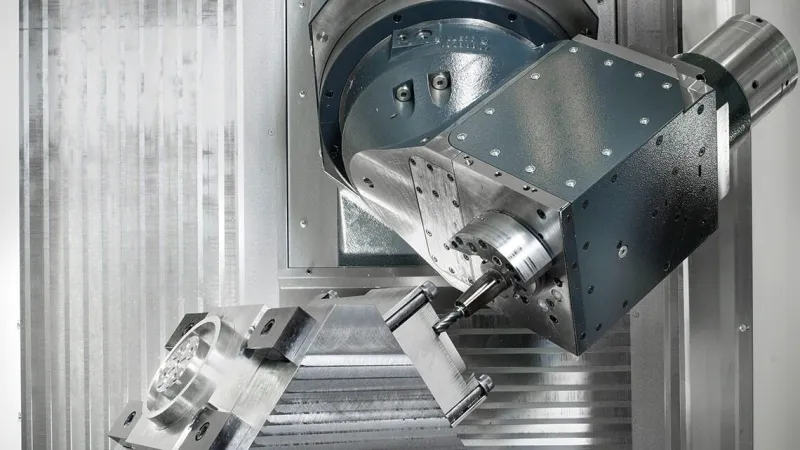
The origins of 5-Axis Machining, a cornerstone of modern CNC machining, are as fascinating as the technology itself. It emerged from the need to solve complex manufacturing challenges, especially in the aerospace industry where precision and complexity are paramount. This journey from its inception to the current advancements illustrates the relentless pursuit of precision and efficiency in manufacturing.
- Who and when was 5-axis machining invented?
The birth of 5-axis machining is attributed to the innovative efforts of pioneers in the mid-20th century. During this era, the need to machine complex parts, especially in the aerospace sector, led to exploration beyond the traditional 3-axis capabilities.
Whether the specific individual or group responsible for this groundbreaking invention remains a subject of debate among historians and engineers. However, it is widely accepted that this development was a collaborative effort, driven by the growing demands of the aerospace industry.
How 5-Axis CNC Machining works
5-Axis CNC machining is the epitome of advanced manufacturing technology. It is not just about subtractive manufacturing; it is about redefining precision and pushing the boundaries of what is possible in CNC machining. This section will analyze the functions and operations of a 5-axis CNC machine, providing a clear understanding of its complex yet fascinating operations.
- What does the “5” in 5-Axis stand for?
Understanding the five axes in 5-axis machining is key to appreciating its capabilities. Each axis represents a unique direction in which the cutting tool or workpiece can move, allowing for complex designs and high precision in manufacturing. Let’s break down what each axis means:
X-Axis: This is horizontal movement along the length of the machine bed. This is the basic movement for most CNC machines, including 5-axis variants.
Y-axis: Working in conjunction with the X-axis, the Y-axis represents horizontal movement perpendicular to the X-axis. It extends the machining capabilities from a linear field to a planar field.
Z-axis: Vertical movement, allowing the cutting tool to move up and down. This axis is important for depth control in machining processes.
A-axis: This axis allows for rotation around the X-axis. This axis is important for reaching corners and edges of the workpiece that cannot be reached using only X, Y, and Z movements.
B-axis: Similar to the A-axis, the B-axis provides rotational motion but around the Y-axis. This additional rotational motion further enhances the machine’s ability to create complex geometries.
What is a 5-axis configuration?
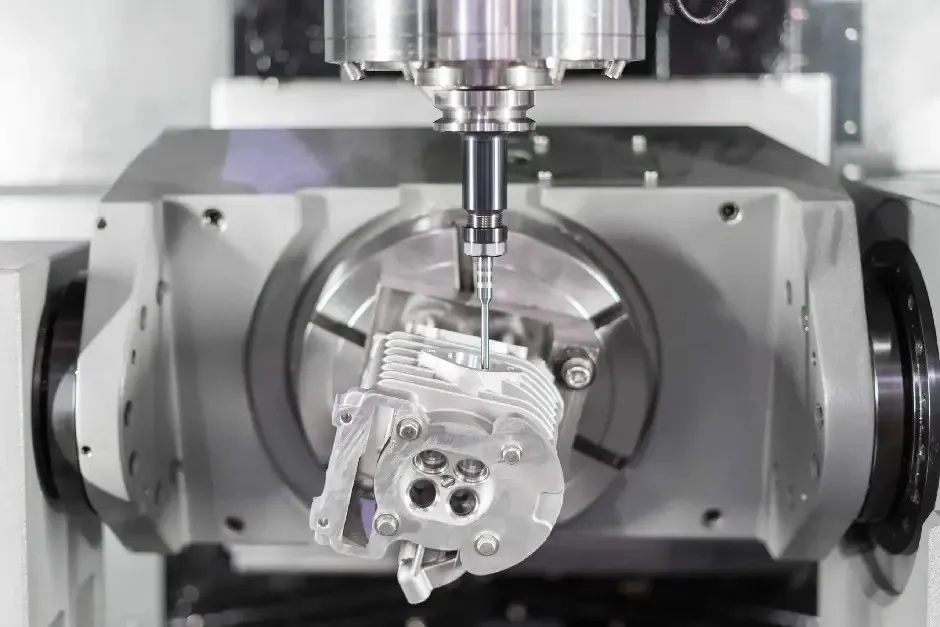
5-axis CNC machines, known for their versatility and accuracy, come in a variety of configurations. Each configuration offers its own benefits and is suited to specific applications. Understanding these configurations is essential for manufacturers and machinists to choose the right machine for their specific needs.
- Trunnion Table Configuration
The trunnion table configuration in 5-axis machines is a popular choice due to its durability and accuracy. Here's how it works:
- A trunnion table is essentially a rotary table that tilts the workpiece toward the spindle, allowing access to multiple sides of the part in a single setup.
- This configuration is known for its high stability and support, especially for heavy or large workpieces.
- The pivot pin setup reduces the need for multiple setups, reducing time and increasing accuracy.
- It is ideal for complex parts, such as aerospace parts, where accuracy is paramount.
- Rotary Head Configuration
Rotary head configurations offer a different approach to 5-axis machining:
- In this setup, the spindle head moves instead of the table. The head can rotate and pivot, providing additional axes of motion.
- This configuration allows for more flexibility in tool positioning and angle, which is important for complex designs and complex geometries.
- Rotary head machines are typically faster and more dynamic, making them suitable for detailed and precise work where the tool needs to approach the workpiece from a variety of angles.
- They are often preferred for smaller parts where the high degree of articulation and high speeds can be utilized.

What types of 5-axis CNC machines are there?
5-axis CNC machines come in a variety of configurations and capabilities. Understanding these types is critical for manufacturers to fully exploit the potential of 5-axis technology in their specific applications.
- 5-axis Head/Head Machine
Technical Description: 5-axis Head/Head machines feature both a rotating head and a tilting head. This dual motion allows complex machining tasks to be performed with high precision.
Advantages:
- Improved accuracy and flexibility in tool positioning.
- Ability to machine complex shapes and fine details.
- Reduces the need for multiple setups, improving productivity.
Applications:
- Ideal for aerospace and automotive parts.
- Suitable for complex molds and dies.
- Preferred in applications requiring high geometric accuracy.
- Table/Head 5-Axis Machine
Technical Description: In a Table/Head 5-Axis Machine, the table rotates and tilts, while the head mainly moves along linear axes.
Advantages:
- Higher stability for heavy or large workpieces.
- Effective in processing a variety of part shapes.
- Suitable for both roughing and finishing operations.
Applications:
- Effective for large aerospace parts and heavy industrial components.
- Used in energy industry manufacturing, such as turbine blades.
- Suitable for large molds and patterns.
- Table/Head 5-Axis Machine
Technical Description: A Table/Head 5-Axis Machine consists of a table that can perform both rotation and tilting actions, providing distinct operational benefits.
Advantages:
- Suitable for parts that require simultaneous 5-axis motion.
- High precision and control of complex geometries.
- Versatile in handling different workpiece sizes and shapes.
Applications:
- Suitable for medical components such as implants.
- Used in the production of complex, high-precision parts.
- Suitable for custom or specialized machining tasks.
What processes use 5-axis machines?
5-axis CNC machines are not limited to traditional milling operations. Their versatility allows them to be used in a variety of processes, each taking advantage of their unique capabilities to improve production and efficiency. Here are some of the different processes that use 5-axis machines:
- 5-axis milling: The most common application, where the machine performs cutting operations on the workpiece from five different axes simultaneously. Ideal for complex shapes and high-precision parts.
- 5-Axis Waterjet Cutting: Uses a high-pressure stream of water, sometimes mixed with abrasives, to cut through material. 5-Axis Waterjet Cutting is used to cut complex designs and shapes in a variety of materials, from metals to composites.
- 5-Axis Laser Cutting: Uses a focused laser beam to cut or engrave material. This process is known for its precision and is widely used in the electronics and aerospace industries.
- 5-Axis Grinding: Involves using a rotating grinding wheel to remove material from the workpiece. This is especially useful for producing high-precision parts and tools.
- 5-Axis Plasma Cutting: Similar to waterjet cutting, but uses a plasma torch to cut through conductive materials, such as steel and aluminum. This method is commonly used in the automotive and construction industries.
Which parts are suitable for 5-axis machining?
5-axis machining, with its advanced capabilities, is especially suitable for parts that require complex geometry and high precision. Different types of parts benefit from the unique capabilities of 5-axis CNC machines, allowing for complex designs and superior surface finishes. Here are some of the parts that are best suited for 5-axis machining.
- Complex surface parts
These parts are characterized by complex surfaces and detailed shapes.
Typical features:
- Non-linear surfaces, requiring complex toolpaths.
- Complex shapes that cannot be machined with 3-axis machines.
- Require high precision with tight tolerances.
Applications:
- Aerospace components such as turbine blades.
- Automotive parts such as engine components.
- Medical implants that require complex shapes and high-end surface finishes.
- Disc Parts
Disc parts are round and flat, often requiring precision machining on both sides.
Typical features:
- Requires uniform machining on both sides.
- Often includes complex patterns and precision holes.
- High accuracy requirements for balance and symmetry.
Applications:
- Automotive brake discs.
- Precision gears and flywheels.
- Machine parts requiring rotational balance.
- Box-type parts
These are parts with a predominant cubic or box shape, requiring precision machining on multiple sides.
Typical features:
- Requires machining on multiple sides, often in a single setup.
- Accuracy in corner detail and edge finish.
- Various sizes, from small boxes to large housings.
Applications:
- Housing for electronic devices and machinery.
- Machine tool components.
- Parts requiring complex internal pockets and external geometries.
- Special-shaped parts
Special-shaped parts are parts with unique, non-standard shapes.
Typical features:
- Unconventional shapes requiring adaptive tool paths.
- Complex internal structures and channels.
- High degree of customization and precision.
Applications:
- Custom parts for specialized machinery.
- Prototypes and parts for research and development.
- Art and decorative works requiring high detail and precision.
What are the different applications of 5-axis machining and the industries that benefit from it?
5-Axis CNC Machining, with its unparalleled precision and versatility, is used in a wide range of industries. This advanced technology has revolutionized the way complex parts are manufactured, providing solutions to some of the most challenging manufacturing needs.
- Aerospace
The aerospace industry benefits greatly from the capabilities of 5-axis machining, especially for components that require high precision and complex geometry.
- Turbine blades have complex shapes and tight tolerances.
- Structural components of aircraft, requiring precision machining.
- Engine parts require complex shapes and smooth surfaces.
- Healthcare
In the healthcare industry, the precision and adaptability of 5-axis machining is important, especially for custom and complex components.
- Orthopedic implants such as joint replacements, require high precision.
- Surgical instruments with complex designs.
- Prosthetic limbs are tailored to the needs of each patient.
- Electronics
The electronics industry, known for its small, precise components, uses 5-axis machining for high precision and efficiency.
- Smartphone and computer components, which require high detail.
- Connectors and enclosures with complex shapes.
- Printed circuit board (PCB) hardware and heat sinks with precise dimensions.
- Energy
5-axis machining contributes significantly to the energy sector, especially in the production of components for renewable energy sources.
- Wind turbine components, including gears and rotors.
- Solar panel components, which require precise dimensions.
- Hydropower plant components, including complex turbine blades.
How to maximize the efficiency of 5-axis machining?
5-axis CNC machining offers unparalleled opportunities for producing complex parts with high precision. However, maximizing the efficiency of a 5-axis machine requires a strategic approach, focusing on software, tool detection systems, collision prevention, and mastering the art of milling. Here, we explore these important areas.
- The Importance of Software and Control
Software and control systems in 5-axis machining play a vital role in maximizing efficiency and accuracy.
- Advanced software enables precise control of toolpaths, ensuring accurate and efficient machining.
- Modern CNC control systems enhance machine responsiveness, allowing for faster adjustments and more precise machining.
- Integrated software solutions facilitate seamless communication between design and manufacturing, minimizing errors and improving productivity.
- Implement Tool Detection Systems
Tool detection systems are essential to maintaining efficiency in 5-axis machining.
- These systems monitor tool wear and damage, alerting operators before they cause problems.
- Automatic tool measurement and compensation saves time and reduces human error, ensuring consistent machining quality.
- Implementing these systems can significantly reduce machine downtime and increase overall production output.
- Prevent Collisions
Collision prevention is critical to maintaining the integrity of both the machine and the workpiece.
- Advanced simulation software predicts potential collisions and allows operators to make necessary adjustments before actual machining.
- Setting appropriate safety margins and using real-time monitoring systems can prevent costly accidents.
- Regular operator training in collision avoidance strategies is essential to maintaining a safe and efficient workspace.
- Understanding the Art of 5-Axis Milling
Mastering 5-axis milling is both a science and an art, requiring a deep understanding of the capabilities and limitations of the machine.
- Operators must have a deep understanding of the properties of the material being machined to optimize toolpaths and speeds.
- Understanding the dynamics of 5-axis motion helps program effective machining strategies.
- Continuous learning and experimentation with different techniques and tools can lead to innovative approaches that improve efficiency.
Advantages of 5-Axis CNC Machining
5-Axis CNC machining has revolutionized the manufacturing industry, offering a host of advantages that improve production capacity. Here are some of the key benefits:
- Complex shapes: The ability to machine complex shapes and intricate designs that are simply not possible with traditional 3-axis machines.
- High precision and repeatability: Superior machining accuracy ensures parts are produced consistently with high precision.
- Improved setup efficiency: Reduced setup times as multiple sides of a part can be machined in one setup, resulting in improved production efficiency.
- High surface finish quality: The ability to achieve superior surface finishes reduces the need for additional finishing processes.
- Faster material removal: Efficient material removal rates, especially on complex parts, speed up the manufacturing process.
Disadvantages of 5-Axis CNC Machining
While 5-axis CNC machining offers significant advantages, it also comes with certain limitations and challenges:
- High Cost: The initial investment and maintenance costs for 5-axis machines are typically higher than for traditional CNC machines.
- Programming Complexity: Creating a 5-axis machining program can be more complex, requiring advanced software and skilled programming.
- Skilled Operators: Operating and troubleshooting a 5-axis machine requires a higher level of skill and training.
Debunking Common Myths About 5-Axis Machining
5-axis CNC machining, while a breakthrough in precision manufacturing, is often surrounded by misconceptions. Addressing these misconceptions is important to understanding the true capabilities and limitations of this technology.
- 5-Axis Is only for complex parts
- Fact: While 5-axis machining excels at producing complex parts, its benefits are not limited to that. It also improves efficiency and accuracy on simpler parts.
- Wider Applications: 5-axis machines are versatile, suitable for a wide range of parts from basic to complex designs, providing better access to the workpiece and reducing the need for multiple setups.
- It’s more expensive than it looks
Fact: The initial investment in a 5-axis machine may be higher, but the long-term benefits often outweigh the costs.
Cost-Effective: Reduced setup times, improved surface finish, and the ability to produce complex parts in a single setup can result in significant cost savings in the long run.
- The learning curve is too steep
- Fact: While 5-axis machining does require a learning curve, advances in user-friendly software and training resources have made the process more accessible.
- Manageable Training: Manufacturers increasingly offer comprehensive training programs that make it easy for operators to transition from 3-axis to 5-axis machining capabilities.
The Cost Implications of 5-Axis CNC Machining
While 5-axis CNC machining offers unparalleled capabilities in precision manufacturing, it comes with its own set of economic considerations. Understanding these cost implications is critical for businesses looking to invest in this technology.
- How much does 5-Axis CNC Machining typically cost?
The cost of 5-axis CNC machining varies significantly depending on a number of factors including machine complexity, material requirements, and project-specific requirements.
- Average Hourly Cost: Hourly costs for 5-axis CNC machining can vary widely. On average, businesses can expect to pay between $75 and $250 per hour, depending on the complexity of the part and the level of expertise required.
- Average Price for 5-axis CNC Machines: Prices for 5-axis CNC machines vary as well. Low-end machines can start around $30,000, while more advanced machines, especially those used in precision industries like aerospace and automotive, can exceed $500,000.
- Factors that affect price
- Machine Size and Capabilities: Larger machines with higher capabilities are typically more expensive.
- Software and Controls: Advanced software and control systems can increase costs.
- Machine Brand and Model: Prices can vary significantly between different brands and models.
- Additional Features: Features such as enhanced cooling systems, higher spindle speeds, and additional axes can increase costs.
Alternatives to 5-Axis Machining
- 3-Axis vs. 5-Axis Machining: What’s the Difference?
The world of CNC machining is diverse, with 3-axis and 5-axis machines offering different capabilities, advantages, and limitations. Understanding these differences is essential to choosing the right machining process for your specific manufacturing needs.
- What’s the Difference Between 3+2 and 5-Axis Machining?
- 3+2-axis machining: Involves a 3-axis machine with two additional degrees of freedom, allowing the tool to approach the workpiece from any direction. However, these additional axes do not operate simultaneously. The main advantage of 3+2-axis machining lies in its simplicity and cost-effectiveness for less complex parts. It is ideal for parts that require multiple angular positions but do not require simultaneous movement of all five axes. This makes it a suitable choice for many applications, especially where the complexity of 5-axis machining is not required.
- 5-axis machining: All five axes operate simultaneously, allowing for the efficient machining of complex shapes and cutting paths. The ability to maintain optimal cutting angles and constant chip loading results in faster cutting speeds, higher accuracy, and better surface finishes. This simultaneous operation is especially beneficial for aerospace components, medical devices, and complex molds that require precise contours and details. Another significant advantage is reduced setup time, as the part does not need to be repositioned as often.
Furthermore, 5-axis machines often come with advanced software and control systems that enhance their capabilities. These systems offer greater flexibility in toolpath planning and can significantly reduce the risk of tool chatter, which is especially useful in complex machining operations.
While 3+2-axis machining offers simplicity and cost-effectiveness for less complex parts, 5-axis machining offers superior precision, flexibility, and efficiency for complex and sophisticated geometries.
- 5-axis machining vs. 3D printing
Comparing 5-axis machining and 3D printing reveals distinct advantages in various areas:
- Accuracy: 5-axis machining typically offers higher precision than 3D printing.
- Material Range: While 3D printing is versatile with a wide range of materials, 5-axis machining can handle a wider range of industrial-grade materials.
- Production Speed: 3D printing is typically slower than 5-axis machining for most materials and part sizes.
- Surface Finish: 5-axis machining typically provides a better surface finish.
- Complexity and Geometry: Both methods can produce complex geometries, but 5-axis machining has the advantage of precision and surface finish.
- Cost: Cost effectiveness depends on the volume and complexity of the parts. 3D printing can be more cost-effective for small batches and complex geometries.
- Winner: Both have their advantages, but 5-axis machining is often preferred for its high accuracy, high-quality surface finish, and faster production for large volumes.
Conclusion
In the dynamic field of CNC machining, 5-axis technology is a beacon of innovation, transforming complex designs into tangible reality with unparalleled precision and efficiency. This comprehensive guide has gone through the complex layers of 5-axis machining, shedding light on its capabilities, applications, and transformative impact on modern manufacturing, laying the foundation for a future where boundaries are redefined and possibilities are endless.
Những câu hỏi thường gặp


