


Conveyor Rollers
Conveyor rollers are an essential solution for any business that wants to optimize transportation operations, improve efficiency and save costs. With flexible operation, durability and diverse applications, conveyor rollers play a fundamental role in the success of every industry.
And that is also the reason why Intech Group is proud to affirm its position as the leading unit in the field of manufacturing and distributing industrial conveyor rollers in Vietnam.
What is a conveyor roller?
Conveyor rollers are an important part of the conveyor system, playing a role in supporting and moving goods smoothly and effectively. This is a precision mechanical product with a unique structure, reasonable accessories, precise assembly and long service life. They have the ability to lubricate against friction, resist impact, eliminate noise and vibration, prevent adhesion and corrosion, and have a smooth surface that is very easy to clean. The stable performance of the rollers can operate the entire conveyor smoothly.
Conveyor roller classification
Classified according to many different criteria, including:
- Based on material: Steel roller, stainless steel roller, plastic roller, rubber roller.
- Based on application: Free conveyor roller, transmission conveyor roller.
Basic structure of conveyor roller
- The roller structure includes bearings, roller housing, roller shaft and some accompanying components.
- The shaft is the central part of the roller, made of steel or stainless steel, with high hardness and can withstand large loads. The size and thickness of the shaft depend on the load that the roller needs to withstand.
- Bearings are installed at both ends of the shaft, helping the roller rotate smoothly and minimize friction. It can be a ball bearing, tapered roller bearing or self-lubricating bearing, depending on the usage needs. Bearings need to be of good quality, withstand high loads and operate durably.
- The roller body is designed in a cylindrical or tubular shape, and can be made of many different materials such as steel, stainless steel, plastic, rubber, etc.
- The cover can be made of rubber, plastic or metal, which helps protect the roller body and increase the grip of the roller.
- Other parts such as dust cover, oil seal, gasket, etc.
- Standard conveyor roller size:
Below are only standard sizes, the actual size of the roller may vary depending on customer requirements.
| Đường kính con lăn (mm) | Tải trọng tối đa (kg) | Tốc độ vận chuyển tối đa (m/s) |
| 21 | 50 | 0.5 |
| 32 | 70 | 0.6 |
| 42 | 120 | 0.8 |
| 49 | 180 | 1.0 |
| 60 | 300 | 1.2 |
| 76 | 500 | 1.5 |
| 114 | 800 | 2.0 |
Working principle of conveyor roller
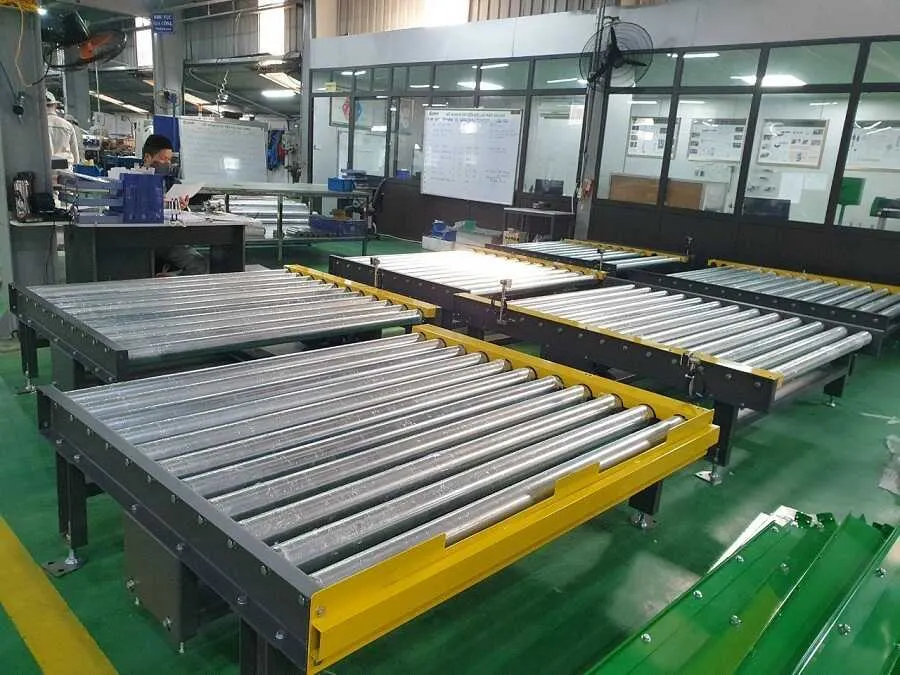
Operating according to a simple mechanism, the conveyor is powered by the movement that makes the roller rotate. The rotation of the roller will push the product along the conveyor. The advantages of roller conveyor are easy installation, quiet operation, energy saving, easy maintenance, low cost, adaptable to many production fields. With roller conveyor during operation, it is also very safe for everyone to work.
The gravity of the conveyor roller will convey light, medium and heavy weight materials with a solid flat bottom such as cartons, boxes, cartons, etc. Roller conveyors eliminate manual and laborious product handling activities, they help move goods over long distances simply and quickly, increasing labor productivity.
Applications of conveyor rollers
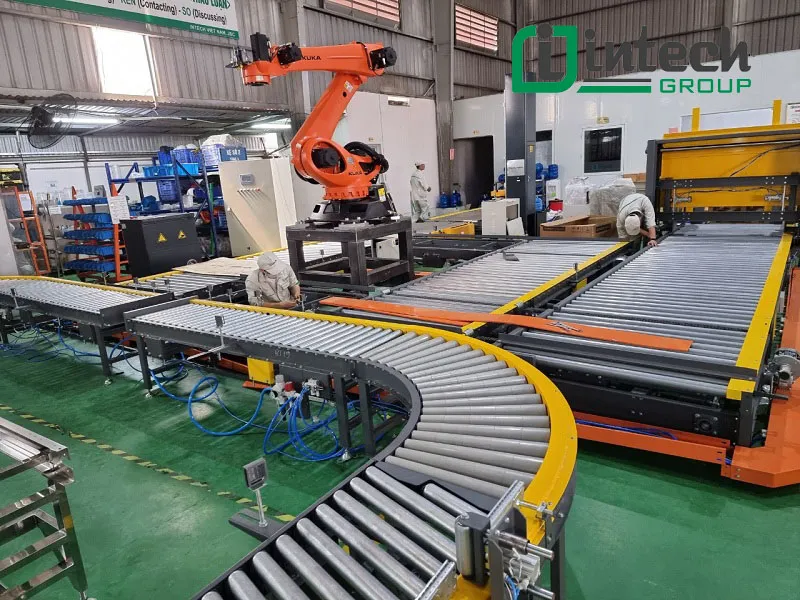
Conveyor rollers play an essential role in the conveyor system, supporting the efficient, safe and cost-effective transportation of goods. Widely used in many industries, including:
- Warehousing industry: Transporting goods between storage, packaging and delivery areas in the warehouse. At the same time, helping to classify and arrange goods by size, weight and product type.
- Manufacturing industries such as food, beverage, automobile, electronics, etc. Transporting raw materials, finished products and semi-finished products between production stages, automating the assembly, processing and manufacturing processes.
- Logistics industry: Transporting goods in distribution centers and warehouses, automating the process of sorting, arranging and transporting goods according to orders.
- In addition, conveyor rollers are also used in many other fields such as airports, stations, ports, etc.
Commonly used types of conveyor rollers:
Rollers are an important part of conveyors, they have the function of transmitting motion to help products move forward. Depending on the properties of the goods to be transported, rollers with different sizes and quantities are selected. Materials commonly used to manufacture conveyor rollers include: Stainless steel, Plastic, Rubber, Steel with high durability.
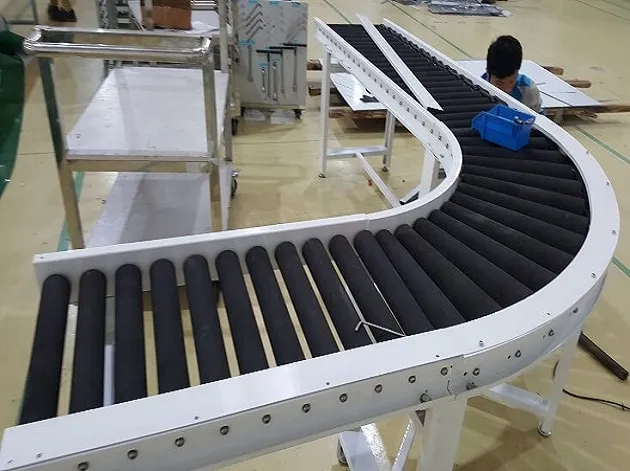
1 - Rubber Conveyor Roller
- Advantages:
- High abrasion resistance and long life, impact and chemicals, durable operation in harsh environments
- 10 times more abrasion resistant than plastic and 7 times more resistant than steel.
- The rubber surface has good grip, helping to prevent goods from slipping off the conveyor belt.
- The rubber-coated roller reduces noise and vibration, can protect the surface of the product during processing.
- Simple design, easy to install and maintain.
- Disadvantages:
- May soften or deform when exposed to high temperatures.
- May become brittle and cracked when exposed to too low temperatures.
- May wear out due to friction with the conveyor belt after a period of use.
- Applications:
- Transporting goods in warehouses, between storage areas, packaging areas and delivery areas.
- Transporting raw materials, finished products and semi-finished products between different stages of production.
- Used in distribution centers to transport goods between receiving areas, storage areas and delivery areas.
2 - Stainless steel conveyor rollers
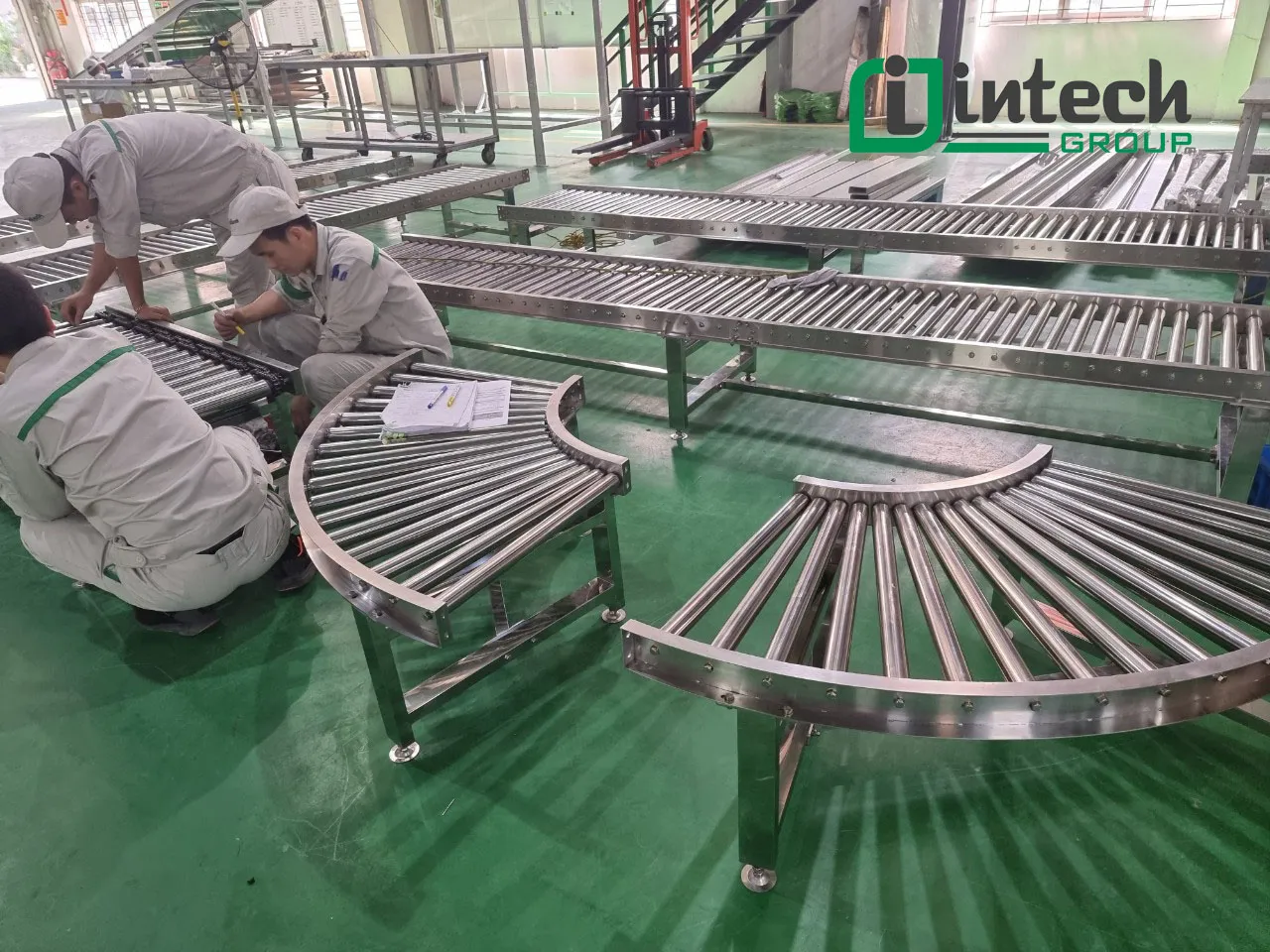
- Advantages:
- Made of high-gloss stainless steel, increasing the aesthetics of the product
- Highly resistant to corrosion, suitable for use in harsh environments such as acid, chemical, salt, seawater, etc.
- Highly durable, withstands heavy loads and strong impacts, helping the roller operate stably for a long time.
- Smooth stainless steel surface, easy to clean and disinfect, ensuring food hygiene and safety.
- Meet strict requirements from handling packaged products to food processing areas that require regular and continuous cleaning.
- Disadvantages:
- Higher cost than other materials such as steel or plastic.
- Applications:
- Transporting raw materials, finished products and packaged products in environments requiring high hygiene such as the food and beverage industry
- Transporting raw materials, finished products and medicines in sterile environments of the pharmaceutical and chemical industries
- Transporting electronic components in environments requiring high precision.
3 - Plastic conveyor rollers
- Advantages:
- Made of lightweight plastic, helping to reduce the load on the conveyor system and save operating energy.
- Highly smooth, low noise, suitable for use in environments requiring quietness.
- High corrosion resistance, can be used in humid conditions.
- With low cost, this is a good choice to replace stainless steel rollers or steel rollers
- Has good anti-static ability, helping to minimize the risk of explosion in explosive environments.
- Because it is made of plastic, the color of the roller is also diverse, with gray and blue for you to choose from
- Disadvantages:
- Has lower durability than steel rollers and stainless steel rollers, is easily worn and damaged in harsh environments.
- Can only withstand low loads, not suitable for conveyors transporting heavy goods.
- Poor heat resistance, easily deformed or melted in high temperature environments.
- Cannot withstand strong impacts, easily cracked.
- Application:
- Used in conveyors to transport lightweight materials. They are popular in pharmaceutical, food, and beverage factories. In addition, we can see them used in packaging and carton factories.
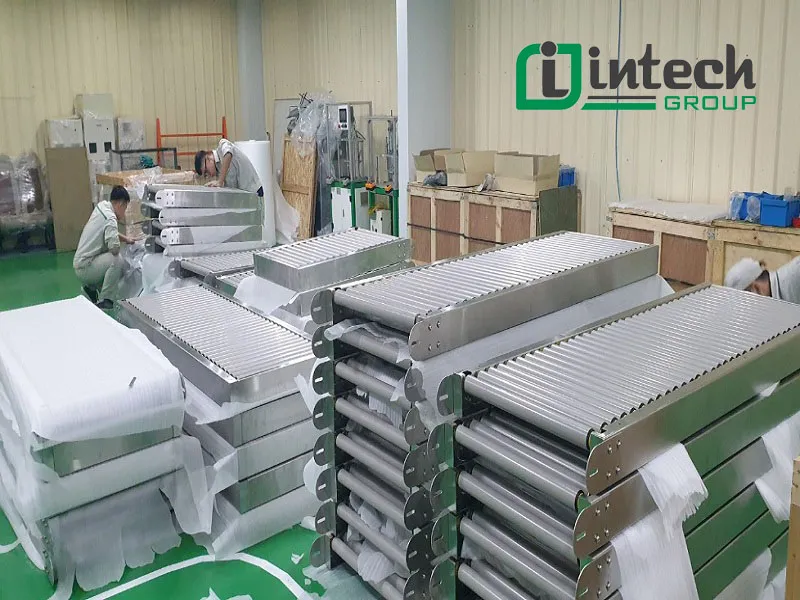
4 - Steel conveyor rollers
- Advantages:
- Made of steel with a variety of features, dustproof, anti-abrasion, can work in many different environmental conditions.
- Has good heat resistance, does not deform or melt in high temperature environments.
- Steel is also preferred over aluminum in environments where rollers will need to withstand higher temperatures (up to 350 degrees).
- With easy-to-clean steel rollers, it is a popular choice for environments with strict hygiene conditions.
- Cheaper than stainless steel
- Disadvantages:
- Heavier than plastic rollers and stainless steel rollers, increasing the load on the conveyor system and consuming more operating energy.
- Has a higher noise level than plastic rollers, not suitable for use in environments that require quietness.
- Susceptible to rust in humid, chemical environments, requiring proper storage and maintenance.
- Applications:
- Transporting raw materials, finished products and semi-finished products in manufacturing plants.
- Transporting goods in warehouses and distribution centers.
- Can handle heavy-duty materials easily, helping to increase labor productivity.
- This roller system is widely used in industries such as electronics, food, pharmaceuticals, etc.
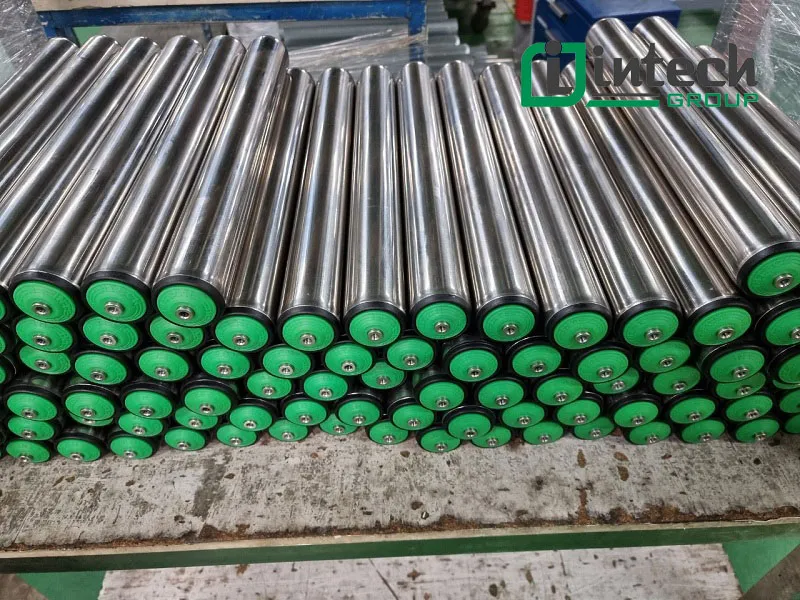
Intech Conveyor Rollers: Quotation and processing of high-quality conveyor rollers, on request
Intech Conveyor Rollers are an essential and reliable solution to optimize internal transport performance, minimize operating costs and improve productivity for businesses. Intech Group has affirmed its position through roller products that meet international standards, widely used both domestically and exported to markets such as Japan, Europe, and North America.
Outstanding features of Intech Conveyor Rollers:
1. Quality meets international standards
- ISO 9001:2015 standard: Each roller is manufactured and strictly inspected through each stage, from processing to assembly, ensuring accuracy, durability, and aesthetics.
- Concentricity and grease retention: Intech pays special attention to concentricity and lubrication, helping the roller operate smoothly, reduce friction, and prolong its life.
- Anti-corrosion and anti-static: The rollers are designed with anti-static properties, suitable for sensitive industries such as electronics and pharmaceuticals.
2. Diverse materials and designs
Intech Group provides a variety of rollers to suit each specific application:
- Material: Galvanized steel, 304 stainless steel, plastic (PVC, PU, PP), rubber, or aluminum, ensuring load-bearing capacity, abrasion resistance, and operation in harsh environments (temperatures from -20°C to +80°C).
- Roller types: Including free rollers, chain drive rollers, conical rollers, ball rollers, and plastic-coated rollers, meeting the transportation needs from light goods (cartons) to heavy goods (pallets).
- Customized sizes: Diameter (Ø25, Ø32, Ø38, Ø50, Ø60, etc.) and roller length are machined according to customer requirements.
3. Outstanding features
- Smooth operation, noise reduction: High-quality bearings (ball bearings, tapered roller bearings) and precise design help reduce vibration and noise during operation.
- High load capacity: Bearing assembly, polymer housing, and sealed cover ensure the roller can withstand large loads, suitable for block products, cartons, or pallets.
- Easy maintenance and cleaning: Smooth, anti-stick surface, and water and dust resistant design make the roller easy to clean and maintain.
Why choose Intech conveyor roller?
- Brand reputation: With more than 14 years of experience, Intech Group is a pioneer in Vietnam, trusted by major domestic and foreign partners (Japan, Europe, North America).
- Large-scale production: Owning modern factories in Hanoi and Ho Chi Minh City, Intech meets large orders with fast delivery times.
- Customizable: A team of highly skilled engineers designs and manufactures rollers according to the customer's specific size, material, and application.
- Professional service: 24/7 quick consultation and quotation support, along with dedicated warranty and maintenance.
- Competitive price: Autonomous in the entire production process from research, processing to assembly, ensuring optimal cost and superior quality.
Intech conveyor roller price estimate:
Intech Group conveyor roller price ranges from 70,000 - 800,000 VND/roller depending on material, size, and type of roller:
- Plastic roller: Price ranges from 70,000 - 300,000 VND/roller, depending on size and features (lightweight, anti-static, used for light goods).
- Galvanized steel roller: Price around 110,000 - 500,000 VND/piece, suitable for medium and heavy goods.
- 304 stainless steel roller: Price from 200,000 - 800,000 VND/piece, used in food, pharmaceuticals, or harsh environments.
- Rubber coated roller: Price from 150,000 - 600,000 VND/piece, depending on the coating thickness and size.
- Conical roller: Price is higher, around 250,000 - 700,000 VND/piece, due to the special design for curved conveyors.
Contact Intech Group now for advice and quotation on the most suitable conveyor roller for your production line!
Order information:
- Address: Lot 6, Lai Xa Industrial Park, Tay Tuu Ward, Hanoi City
- Hotline: 024 66 806 795
- Email: info@intech-group.vn
Những câu hỏi thường gặp


