

AGV Robot
In the era of Industry 4.0, AGV autonomous robots are becoming "powerful assistants" for modern factories, especially in the role of automatic towing robots. Designed to intelligently transport components, goods or carts, AGV not only optimizes the production process but also minimizes dependence on manual labor.
What is AGV autonomous robot?
AGV autonomous robot (Automated Guided Vehicle), also known as AGV or Towing Robot, is an automatic vehicle that uses guidance technology to transport goods and materials to designated locations without human intervention.
Benefits of using AGV autonomous robots in modern industry
AGV robots bring many outstanding benefits, helping businesses optimize production processes, logistics and warehouse management.
- Increase production productivity: AGV transports goods continuously 24/7 without rest, ensuring on-time delivery, reducing waiting time in the production line.
- Reduce labor costs: Replace manual tasks such as pulling goods, helping businesses save manpower and long-term operating costs.
- High accuracy: With a guidance system (magnetic tape, laser, SLAM), AGV moves precisely along the route, minimizing errors compared to humans.
- Optimize factory space: Compact design, does not require wide aisles, suitable for both narrow spaces and large factories.
- Enhance safety: Safety sensors (LIDAR, ultrasound) help detect obstacles, reduce the risk of work accidents and damage to goods.
- Smart management: Connected to real-time software, AGV allows tracking of goods flow, optimizes schedules and improves management efficiency.
- Flexible application: Can be customized to pull goods, lift pallets or integrate conveyors, meeting diverse needs from automobile manufacturing to warehousing.
- Protect goods: Automatic, stable operation, limiting collisions or damage due to improper manual handling.
- Comprehensive automation support: Integrate with MES, SCADA systems or industrial robots, bringing businesses closer to smart factories (Smart Factory).
- Energy saving: Using high-performance batteries (such as lithium-ion), durable operation with low maintenance costs, environmentally friendly.
With these benefits, AGV autonomous robots are not only a transportation tool but also a strategic solution to help businesses improve performance, cut costs and compete strongly in the Industry 4.0 era. AGV products from Intech Group, such as ITA-01 and ITA-02, are a testament to the perfect combination of technology and practical value.
Contact a reputable AGV Robot Supplier today!
Do you want to improve production efficiency and optimize the transportation process in your factory? AGV Robot is the solution you are looking for!
Contact Intech Group, the leading supplier in Vietnam of modern AGV lines such as ITA-01 and ITA-02. With a team of experienced experts and dedicated support services, we are committed to providing the most suitable automation solution for your business.
Call Hotline 0966 966 032 or send an email: info@intech-group.vn for free consultation and experience advanced AGV technology today!
-
![AGV Robot for Assembly Plant]()
AGV Robot for Assembly Plant
-
![AGV system for casting machine]()
AGV system for casting machine
-
![AGV Robot towing goods automatically]()
AGV Robot towing goods automatically
-
![AGV ITA-02 Autonomous Robot]()
AGV ITA-02 Autonomous Robot
-
![AGV ITA-01 Autonomous Robot]()
AGV ITA-01 Autonomous Robot
-
![ITA-01 Automatic Cargo Handling AGV Robot]()
ITA-01 Automatic Cargo Handling AGV Robot
-
![ITA-02 Conveyor Integrated Transport Robot]()
ITA-02 Conveyor Integrated Transport Robot
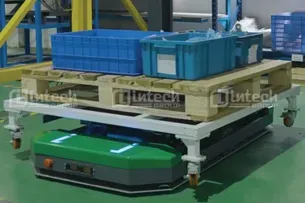
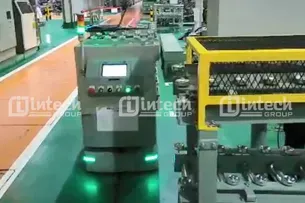


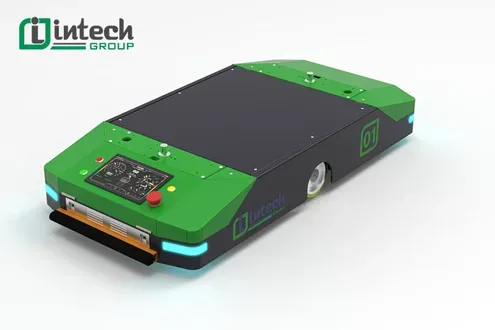


Intech Group manufactures AGV autonomous robots to pull and transport smart goods
Structure of AGV autonomous robots
AGV autonomous robots are intelligent means of transport, designed to automatically move goods in factories and warehouses without human intervention. The structure of AGV includes many important parts, each part takes on a separate function to ensure efficient and safe operation. Below are the main components:
1 - Chassis:
This is the foundation part, usually made of steel or aluminum alloy, providing strength and load-bearing capacity. Depending on the purpose of use, the chassis can support loads from a few dozen kilograms to several tons, and is designed to be compact or expandable as required.
2. Guidance System:
The guidance system is the "compass" that helps AGV move accurately:
- Free Path Navigation: AGV uses gyroscope sensors to determine direction, combined with laser sensors to scan the environment or local positioning system (SLAM) to calculate instantaneous coordinates. Thanks to that, the vehicle automatically finds the shortest path, flexibly moving to any location in the programmed area.
- Fixed Path Navigation: AGV follows a fixed path such as magnetic tape, rail, colored line or magnetic wire. This system is simple, low cost, but the path needs to be reset if the route is changed. Metal, optical or magnetic sensors help the vehicle identify the path.
3. Motor and wheels (Drive System):
AGV is equipped with an electric motor (usually a DC motor) combined with omnidirectional wheels or drive wheels. This system allows the vehicle to move flexibly, turning in place or in different directions, with a maximum speed usually from 10m/min to 60m/min.
4. Battery and charging system:
AGV batteries are usually lithium-ion, lithium iron phosphate (LiFePO4), or lead-acid batteries, providing power for 8-12 hours of operation. The charging system can:
- Automatic charging: The vehicle automatically goes to the charging station when the battery is low.
- Manual battery replacement: Quickly replace the battery at the base station.
5. Control Unit:
This is the "brain" of the AGV, usually using a microprocessor or PLC (Programmable Logic Controller). The controller receives signals from sensors, processes data and commands the vehicle to move according to the programmed route or make immediate adjustments.
6. Obstacle detection sensor:
To ensure safety, AGV is equipped with various types of obstacle detection sensors:
- Ultrasonic sensor: Transmits sound waves, measures reflection time to calculate distance, suitable for hard obstacles such as walls or people.
- Infrared sensor: Uses infrared rays to detect nearby obstacles, works well in low light environments.
- Laser sensor: Scans the environment to create 2D/3D maps, for high accuracy in locating and avoiding obstacles.
7. Collision sensor:
The collision sensor helps AGV stop immediately upon contact with an object, minimizing damage to goods, equipment and the surrounding environment, ensuring maximum safety.
8. Load Handling Mechanism:
Depending on the function, AGV can be mounted:
- Conveyor: To transport goods smoothly.
- Lifting mechanism: Lifts pallets or crates to a certain height.
- Towing pin: Pulls the cart behind, as in Intech Group's towing AGV lines.
9. Communication System:
Including Wi-Fi, Bluetooth or RF modules, allowing AGVs to connect to central management systems (MES, WMS) or receive remote commands. This supports real-time vehicle status monitoring and route optimization.
10. User interface:
The interface includes a display screen (location, status), buttons (start, stop), indicator lights and mechanical handles, making it easy for operators to interact and control.
Thanks to the tight combination of the above components, AGV autonomous robots operate efficiently, meeting transportation needs in industries such as automotive manufacturing, electronics, logistics and more. Modern AGV lines, such as Intech Group products, also allow customization to suit each specific application, bringing optimal value to businesses.
How does an AGV work?
AGVs rely on automation and intelligent control technology to transport goods without human intervention. Here is a basic process of how AGVs operate efficiently in factories and warehouses:
- Programming and mapping: AGVs are pre-programmed with a map of the working environment through management software or a central control system (MES), including routes, destination locations, restricted areas, and stops. This helps the vehicle determine the optimal route before operating.
- Environment detection: AGVs use sensors such as ultrasonic, infrared, laser, or proximity to collect information about their surroundings. These sensors determine location, detect obstacles, and accurately guide movement.
- Data processing: The central processor (PLC or microchip) receives data from sensors, analyzes the current location, destination and other factors to calculate the shortest path and make instant decisions.
- Movement control: The control system (using PID or linear method) adjusts the speed, direction and trajectory. The electric motor combined with omnidirectional wheels ensures that the AGV moves flexibly and stably.
- Connection and communication: The AGV can communicate via Wi-Fi, RF or cable with the management system (MES), receive remote commands and send real-time data on operating status.
- Task execution: Depending on the design, the AGV can: Pull a cart with a connecting pin (like Intech Group's ITA-01), Lift and lower pallets or containers with hydraulic mechanisms, transfer goods via integrated conveyors (like ITA-02).
Thanks to this process, AGVs operate efficiently, minimize errors and replace manual labor, bringing great value to modern production and logistics. AGV products from Intech Group are a typical example, with flexible guidance technology and superior customization capabilities.
Disadvantages of AGV Robots to Note
Although AGV robots bring many outstanding benefits in production and logistics, there are still some disadvantages that businesses need to note before deploying:
- High initial investment costs: Purchasing, installing and integrating AGVs into the production system requires a large investment, especially with lines using advanced technology such as laser or SLAM. This can be a challenge for small businesses.
- Dependent on infrastructure: AGVs running on paths (magnetic tape, colored lines) require the establishment and maintenance of fixed infrastructure. If the route changes, businesses have to spend money and time reconfiguring.
- Limitations in complex environments: In crowded areas, unexpected obstacles, or spaces that are not pre-programmed, AGVs may perform poorly or require more expensive sensors.
- Maintenance and upgrade costs: Batteries, sensors, and motors require regular maintenance. Technology or software upgrades can also incur significant costs.
- High technical requirements: Deploying and operating AGVs requires highly trained staff to troubleshoot, program, and integrate with systems such as MES or SCADA.
- Limited adaptability with some lines: Low-cost AGVs (such as the ITA-01 line from Intech Group) may be limited in flexibility, making it difficult to customize for more complex tasks such as lifting or integrating conveyors.
Understanding these disadvantages helps businesses carefully consider, choose the right AGV line, and prepare the infrastructure to optimize operational efficiency.
Applications of AGV Robots in Modern Industry
Automated Guided Vehicle (AGV) robots have become an indispensable part of industries, helping to optimize transportation processes and improve efficiency. Below are some of the outstanding applications of AGV:
- Transporting components in production: AGVs move components and raw materials between stations in automotive, electronics or mechanical production lines, ensuring on-time delivery and reducing errors.
- Smart warehouse management: AGVs transport goods from storage areas to packaging or shipping areas, supporting automatic warehouse management at high speed and accuracy.
- Pulling carts in factories: AGV lines such as Intech Group's ITA-01 specialize in pulling carts containing materials or products, suitable for factories with large spaces.
- Automatic pallet lifting and lowering: AGVs are equipped with a lifting mechanism to handle heavy pallets or boxes, commonly found in logistics warehouses or food factories.
- Integrated conveyor belts: AGVs with conveyor belts (such as ITA-02) support the transfer of goods between production stages or from the line to the warehouse, increasing automatic connectivity.
- Applications in special environments: AGVs are used in healthcare (transporting equipment, medicines), agriculture (moving harvested products) or hazardous environments (chemical plants).
- Assembly line support: AGVs deliver components to assembly stations at the right place and time, reducing waiting times and improving production efficiency.
Thanks to their flexibility and customizability, AGV robots meet the diverse needs of industries, from traditional manufacturing to smart factories. AGV solutions from Intech Group are typical examples, bringing superior optimization to businesses.
Comparing the efficiency of AGVs with traditional transportation methods
AGV robots are gradually replacing traditional transportation methods such as handcarts, manual forklifts or workers directly moving goods in factories and warehouses. Here is a detailed comparison of the efficiency between AGV and traditional methods:
Speed and productivity:
- AGV: Continuous transportation 24/7 at a steady speed, programmed to optimize routes, reduce waiting time and increase productivity. For example, AGVs such as Intech Group's ITA-02 can handle dozens of trips per hour.
- Traditional: Dependent on human power or forklifts, slower speed, prone to interruptions due to breaks or errors. Lower productivity, especially during night shifts or high workloads.
Accuracy:
- AGV: Guidance technology (magnetic tape, laser, SLAM) ensures delivery to the right location, at the right time, minimizing errors. Real-time management systems also track progress accurately.
- Traditional: Prone to human error, such as wrong location or delay, especially in complex production lines such as automobile or electronics manufacturing.
Long-term costs:
- AGV: High initial investment costs (purchase, installation, integration), but labor savings, low maintenance, and long-term efficiency, especially with durable lithium-ion batteries.
- Traditional: Low initial costs (only need a cart or hire workers), but labor costs increase over time, plus costs incurred due to errors or accidents.
Safety:
- AGV: Equipped with safety sensors (LIDAR, ultrasound) to detect obstacles, reducing the risk of accidents and damage to goods.
- Traditional: Forklifts or workers are prone to accidents due to fatigue, lack of concentration, especially in crowded or dangerous environments.
Flexibility:
AGV: Easy to reprogram routes, integrated with MES or SCADA systems, suitable for many tasks such as pulling goods, lifting pallets, or transporting conveyors.
Traditional: Less flexible, difficult to adjust when the process changes, depends heavily on the skills of workers or basic equipment.
Impact on space:
- AGV: Compact design, no need for wide aisles, optimizing factory space, especially with lines like Intech Group's ITA-01.
- Traditional: Forklifts or hand trucks require larger spaces, easily causing congestion in small factories.
Automation capabilities:
- AGV: Supports integration into smart factories (Smart Factory), connects with industrial robots and management software, promotes comprehensive automation.
- Traditional: Does not support automation, depends on manual operations, difficult to meet the requirements of Industry 4.0.
Types of AGV Self-Propelled Robots manufactured by Intech Group
Intech Group's AGV self-propelled robot lines are flexibly designed to meet diverse needs in production and logistics. Below are the outstanding AGV robots of Intech Group:
1 - Towing AGV (Towing AGV - ITA-01)
- Description: This is an AGV line specializing in pulling carts or trailers containing components and materials, suitable for factories with large-volume transportation needs. AGV ITA-01 uses an automatic or manual pulling mechanism.
- Guidance technology: Mainly using magnetic tape or laser, ensuring precise movement on a fixed route.
- Application: Automobile production lines, mechanics, or large warehouses, where continuous transportation between areas is required.
- Advantages: Large load capacity (up to several tons), saving time when pulling multiple carts at the same time.
2 - AGV integrated with conveyor (Conveyor AGV - ITA-02)
- Description: This AGV is equipped with a conveyor on the vehicle body, allowing receiving and returning goods directly to the production line or warehouse without manual operation.
- Guidance technology: Laser or SLAM, flexible in changing spaces.
- Application: Beverage, electronic components, or food factories, where goods need to be continuously circulated between stages.
- Advantages: Increase continuity, reduce processing time, easy integration with MES systems.
3 - Pallet lifting AGV (Forklift AGV)
- Description: Designed with lifting forks to handle pallets or heavy boxes, replacing traditional forklifts. This type automatically lifts, lowers and moves goods to the designated location.
- Guidance technology: Laser or magnetic tape, combined with safety sensors to avoid collisions.
- Applications: Logistics warehouses, distribution centers, or food factories where goods need to be loaded onto high shelves.
- Advantages: Safe, precise, minimizing the risk of work accidents.
4 - Custom AGV
- Description: Intech Group provides custom-designed AGV solutions according to requirements, from size, load to functions such as lifting, pulling, or rotating, suitable for specific environments.
- Guidance technology: Choose between laser, SLAM, or GPS (for outdoor AGVs), depending on the application.
- Applications: Chemical plants, medical (transporting equipment), or agriculture (moving harvested products).
- Advantages: Meet specific needs precisely, optimizing efficiency for each business.
AGV Self-Driving Vehicle Quote and Influencing Factors
The price of AGV self-driving robots fluctuates greatly, from tens of millions to billions of VND, depending on many factors. The common price range mentioned is from 200 million to 800 million VND for common types.
Factors affecting the price of AGVs
AGV types and functions:
- Towing AGV: Price from 200-500 million VND, such as Intech Group's ITA-01, suitable for transporting large volumes.
- Forklift AGV: Price around 300-800 million VND, depending on load capacity and lifting height.
- Conveyor AGV: Price from 400-1 billion VND, such as ITA-02, used for continuous production lines.
- Customized AGV: Price is higher, from 500 million to several billion VND, depending on specific requirements.
Guidance technology:
- Magnetic tape or colored stripes: Lowest cost, from 200-400 million VND.
- Laser or SLAM: Higher price, from 400-800 million VND, due to high flexibility and accuracy.
- GPS (outdoor): Usually the most expensive, suitable for special environments.
Payload and size:
- Small payload AGV (under 500 kg): Price from 200-400 million VND.
- Large payload AGV (1-5 tons): Price from 500 million to 1.5 billion VND.
Origin and brand:
- Domestic AGV (such as Intech Group): Cheaper, easier to maintain, ranging from 200-800 million VND.
- Imported AGV: Price is 30-50% higher due to shipping costs and taxes, usually from 500 million to several billion VND.
Additional features:
- Lithium-ion batteries or automatic charging increase the price by 10-20%.
- Safety sensors (laser, LIDAR) or MES/SCADA integration also increase costs.
- This is an estimated price. Actual prices depend on the specific requirements of the business (load, route, system integration).
Contact Intech Group to get an exact AGV Robot quote:
To get a detailed quote and the most suitable AGV solution, you can directly contact Intech Group - a reputable supplier with over 15 years of experience in automation in Vietnam:
- Hotline: 0966 966 032
- Email: info@intech-group.vn
- Website: https://congnghiepviet.com.vn/
Intech Group provides free consulting services, on-site surveys and AGV design according to needs, ensuring optimal costs and high operating efficiency.
Những câu hỏi thường gặp


